

Guides
How to stop snoozing your alarm: a 7-day plan
Snoozing itself isn't the enemy. A snooze that never ends is. Here is why the button wins, what helps, and a one-week plan to get up on the first ring.
By Daniel & Samuel Krucay, co-founders of Wakeletics
· 4 October 2026 · 7 min read
Most advice about snoozing starts by telling you it's bad for your brain. The best study on it doesn't say that, and we've written about it separately. This article is about something else: how to change the habit if you want mornings that start when you meant them to.
The short answer
Set your alarm for the latest time you can actually get up, and get up when it first rings. Make that easier by deciding the night before, moving the phone out of reach and getting light straight away. Use the same wake time on all seven days. If that isn't enough, make the alarm's off switch something you can only do standing up. For what to do once you're up, see the first ten minutes after the alarm.
The rest of this article is why each of those works, and a week-long plan to try them.
Snoozing isn't the problem. Never finishing is.
Two recent studies give a fairly clear picture.
- Snoozing is normal. In more than 3 million nights recorded by a sleep-tracking app worldwide, 55.6% ended with the snooze button. On those mornings, people pressed it 2.4 times and snoozed for about 11 minutes on average (Robbins et al., 2025).
- A short snooze isn't harmful. In a sleep lab, habitual snoozers who snoozed for 30 minutes did as well or better on thinking tests straight after getting up as when they were woken abruptly. They lost only about six minutes of sleep (Sundelin et al., 2024). In the same paper's survey of 1,732 people, snoozing was more common among younger people, people who are naturally late, and people who sleep less.
So if your snooze is ten minutes and then you're up, nothing needs fixing. The habit worth changing is the one where 10 minutes becomes 40, the plan for the morning disappears, and you start the day already behind.
Why the button keeps winning
The decision to get up is made by the least capable version of you. In the first minutes after waking you are under sleep inertia: slower, foggier and worse at making decisions (more on that here). The snooze button asks that person a yes-or-no question every nine minutes, and the bed always has a good answer.
So the fixes below have one thing in common: they move the decision away from that moment, either to the evening before or to something that happens automatically.
Seven things that help
1. Set the real time, not the hopeful one
If you always get up at 7:20 after snoozing from 6:50, your real wake time is 7:20. Set the alarm for 7:20 and sleep those 30 minutes properly instead of in pieces. The researchers behind the 3-million-night study give the same advice: the latest workable alarm, then up on the first ring.
2. Decide tonight what your first move is
Make it specific: When the alarm rings, I sit up and put both feet on the floor. Plans written as if this happens, I'll do that are called implementation intentions. Across 94 studies they made people clearly more likely to follow through (Gollwitzer & Sheeran, 2006). None of those studies were about alarms, but the idea fits well: the decision has already been made, so the sleepy version of you only has to carry it out.
3. Move the phone
If the alarm is beside your pillow, snoozing is one lazy movement. Charge the phone across the room, or where you plan to do your first thing. By the time you reach it, you're already standing.
4. Get light straight away
Curtains open, main light on, or a minute outside. Morning light is the strongest signal your body clock gets, and a normal indoor room gives far less of it than you'd think. More in Light sets your clock.
5. Keep the same wake time all seven days
Sleeping until 10 on Saturday and 6:30 on Monday is like flying across time zones twice a week. It makes Monday's alarm land at a worse time for your body. Keep the weekend within about an hour of the weekday time. Why weekends count.
6. Count the mornings, and don't panic over a miss
Write down every morning you get up on the first ring. Seeing it makes the habit real. When you miss one, carry on the next day: in the classic habit study, a single missed day did not measurably slow down how quickly the habit became automatic. See how long a morning habit takes to stick.
7. Make the off switch need you awake
If the first six aren't enough, change what it takes to silence the alarm. One familiar tap is something you can do half asleep. Getting up and moving isn't. The question to ask about any alarm task is: can I do this lying down?
The 7-day plan
You don't need all seven fixes on day one. Add one each day and keep the earlier ones going.
- Day 1 · Find your real time. Note when you actually got up today. Tonight, set the alarm for that time.
- Day 2 · Write the first move. Before bed, write one sentence: When it rings, I… Keep it physical and short.
- Day 3 · Move the phone. Charge it out of reach tonight, ideally where your first move happens.
- Day 4 · Add light. The moment you're up: curtains, light, or the window.
- Day 5 · One alarm only. Delete the backup alarms in your clock app. Keep one.
- Day 6 · Plan the weekend. Set Saturday's alarm within an hour of your weekday time.
- Day 7 · Count. Look back over the week: how many mornings did you get up on the first ring? That's your starting number. Aim for one more next week.
If you used Wakeletics for the week, the app counts this for you: each morning you got up on the first ring is recorded, and First-Ring Week (five such mornings) is one of the weekly challenges when it comes round.
Where Wakeletics fits
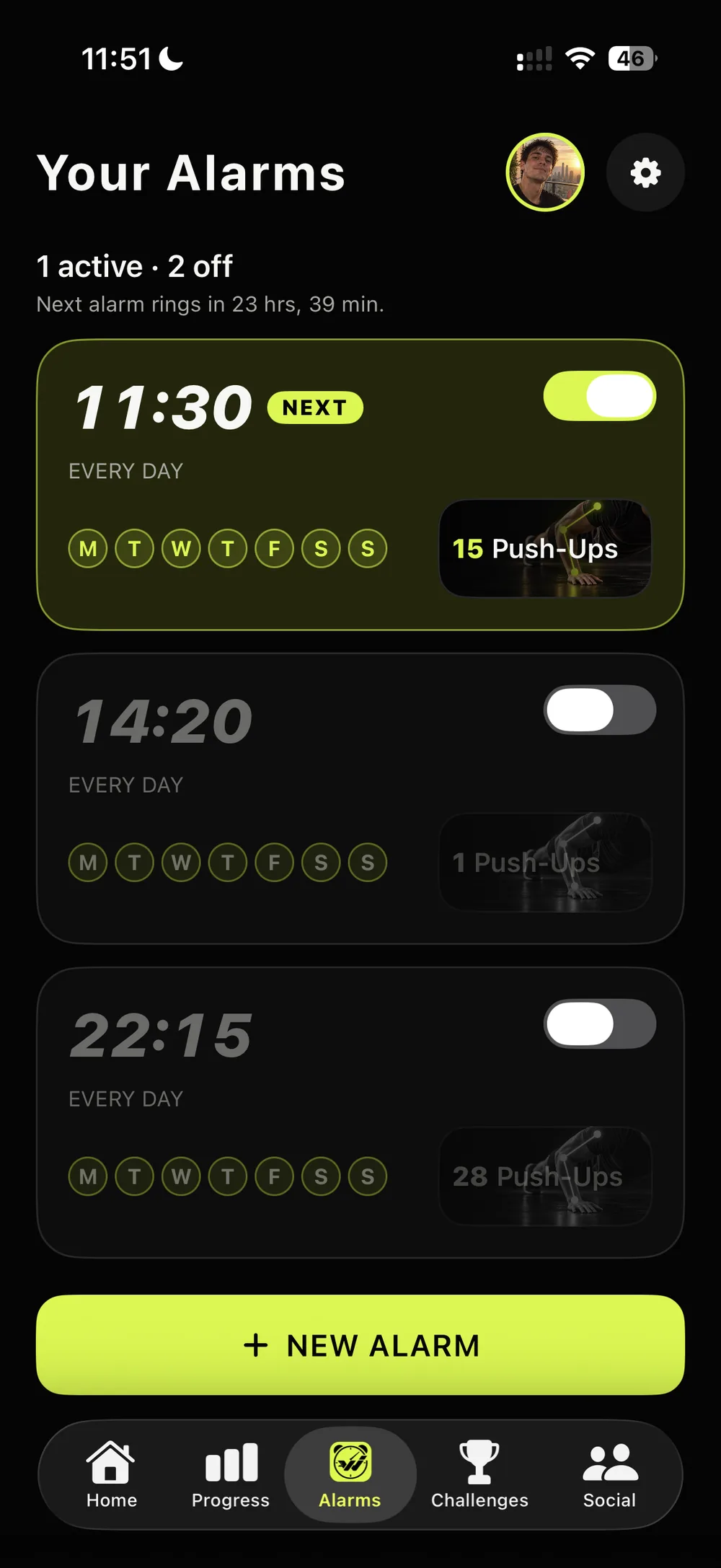
Wakeletics combines several of the fixes in one alarm:
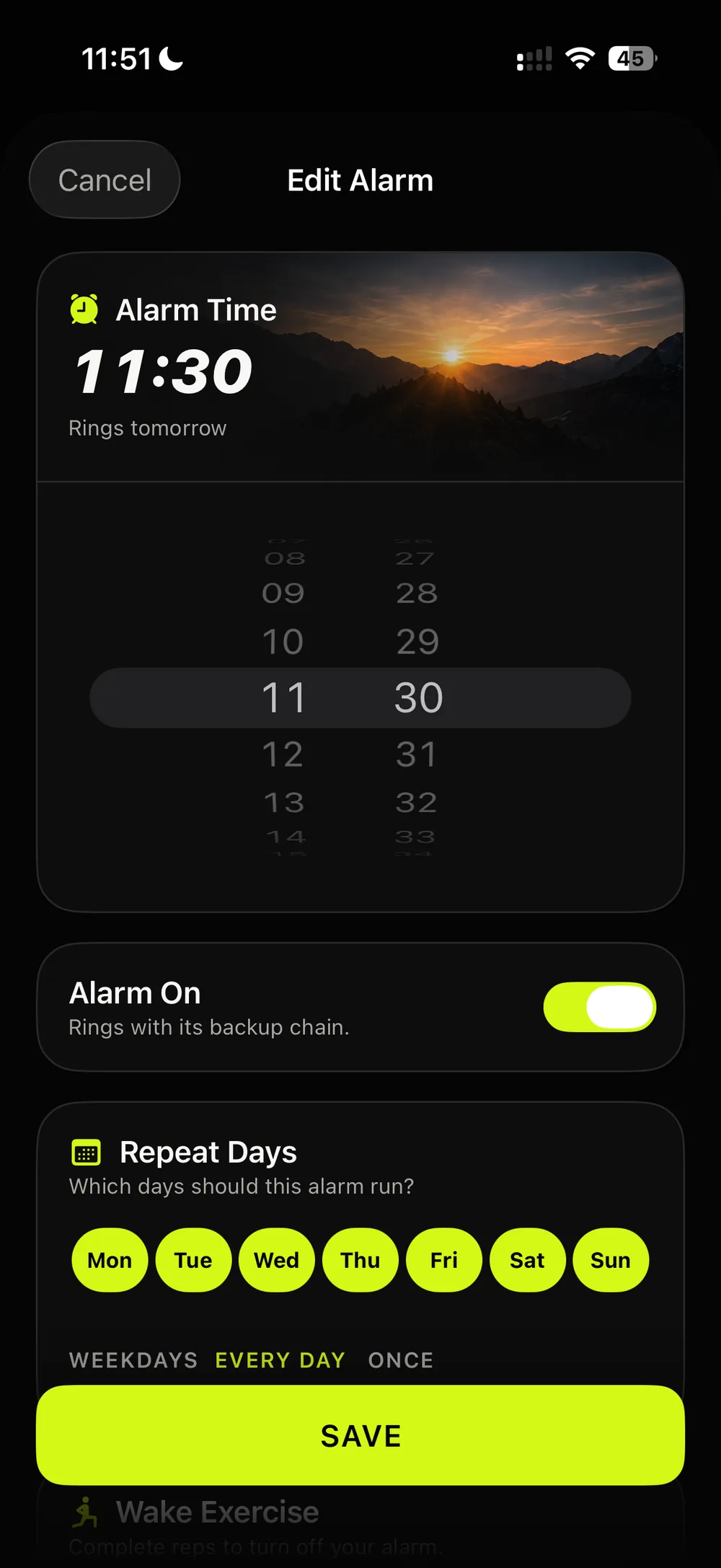
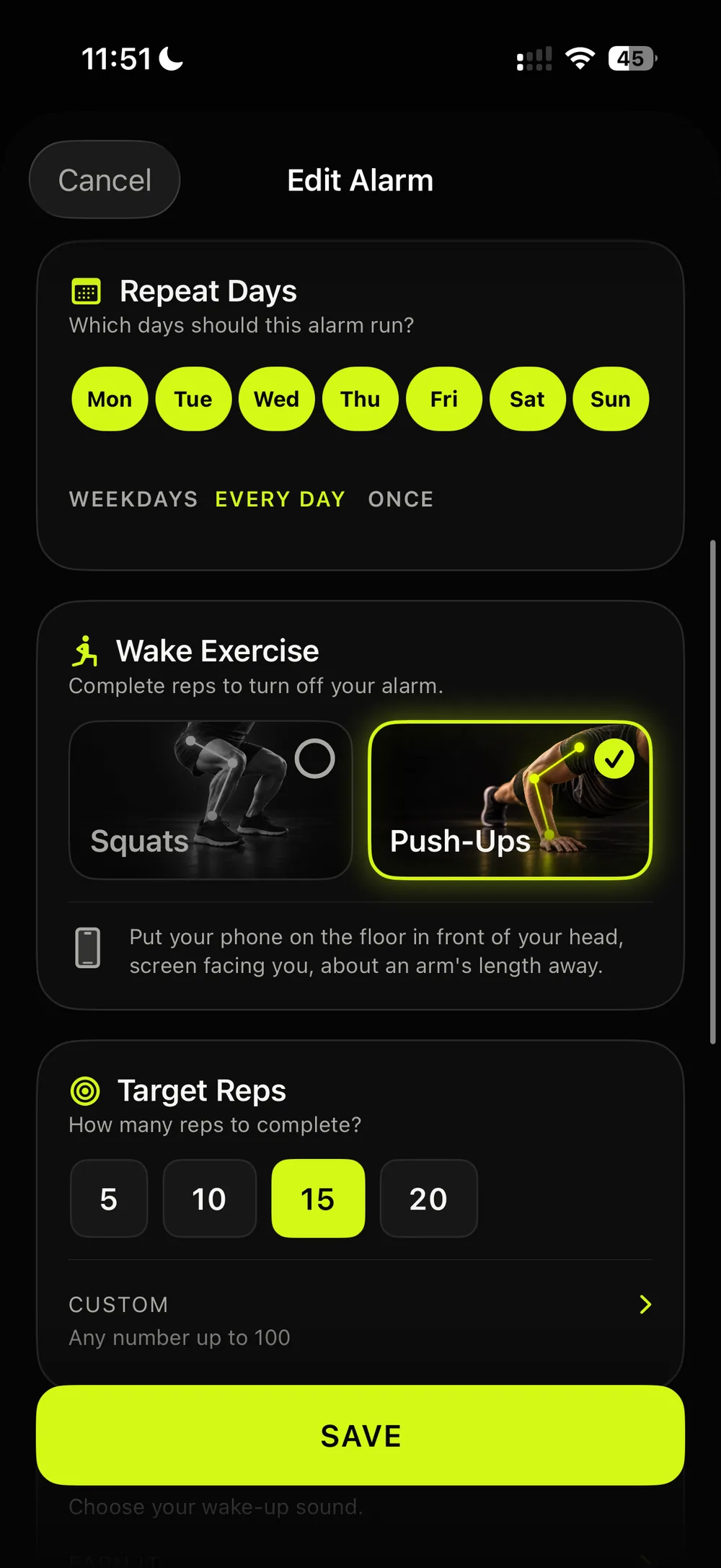
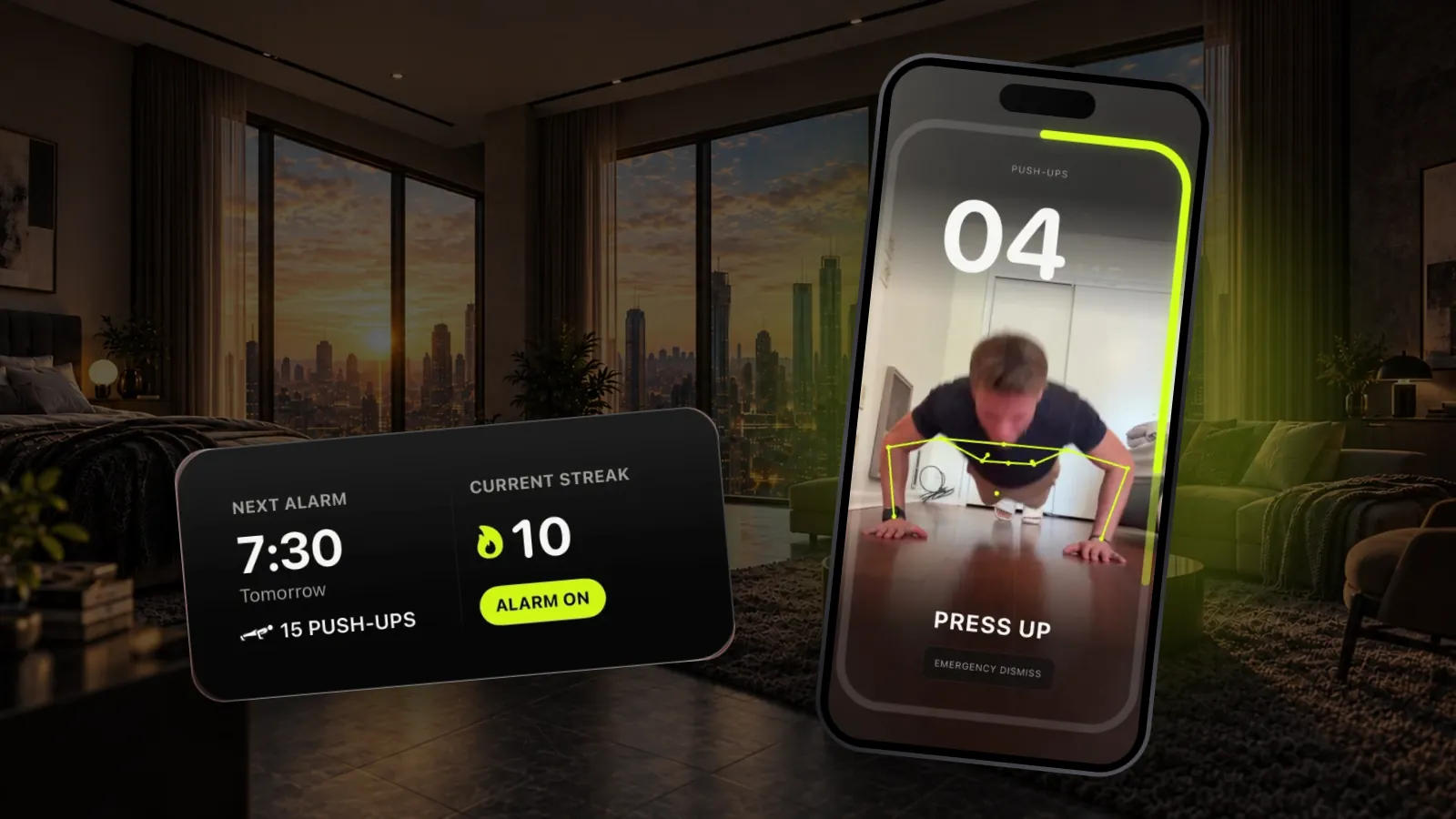
- The decision is made at night. When you set an alarm, you choose push-ups or squats and how many. In the morning there's nothing left to decide.
- The off switch needs you standing. The camera counts each full rep, on the phone itself, with no video recorded or uploaded. The morning counts as earned only when the reps are done.
- A snooze with an end. Instead of snoozing whenever you like, you choose backup rings in advance: Gentle (2 over 5 minutes), Standard (4 over 15) or Relentless (6 over 25). Silence one ring and the next is already coming.
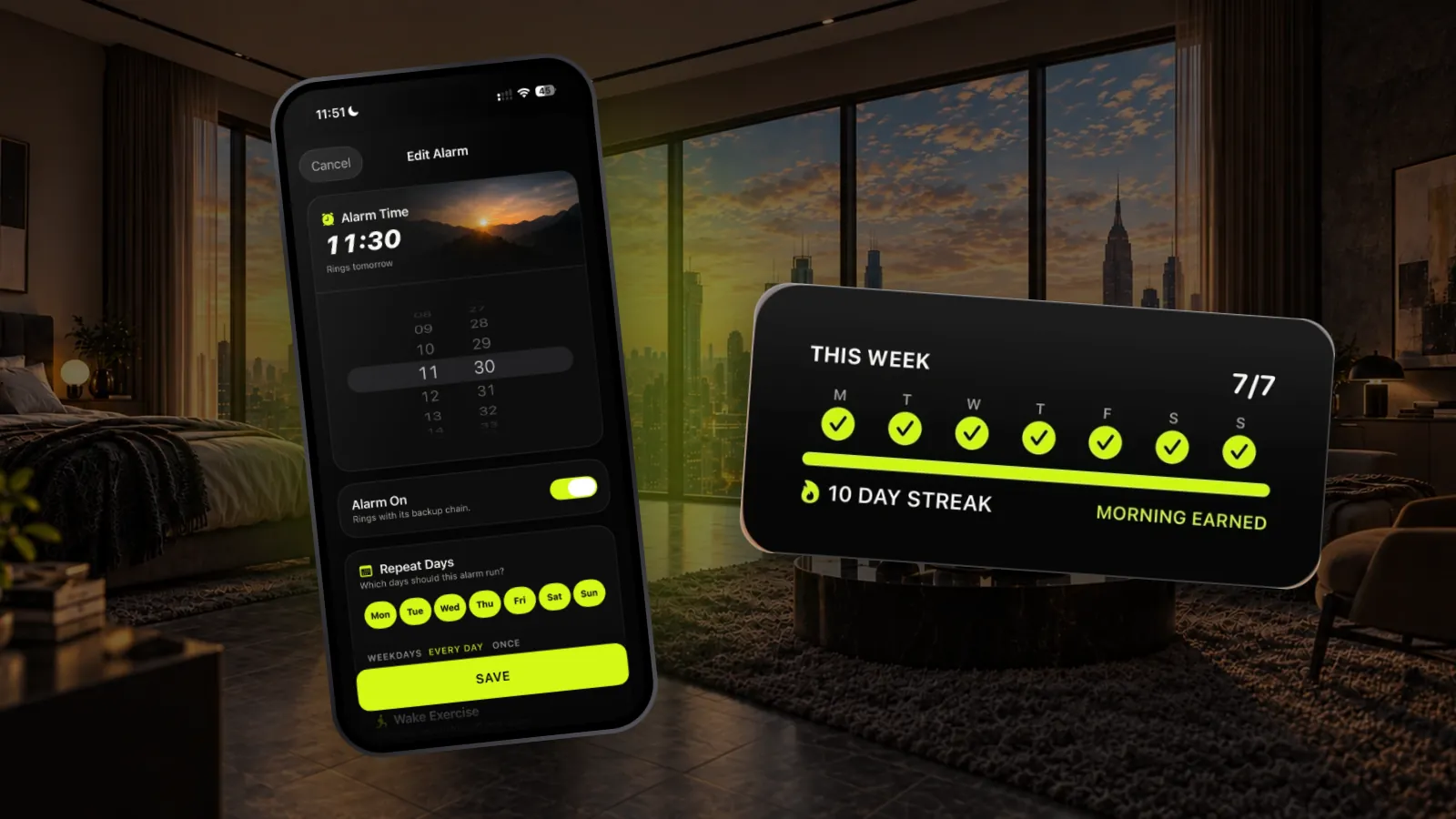
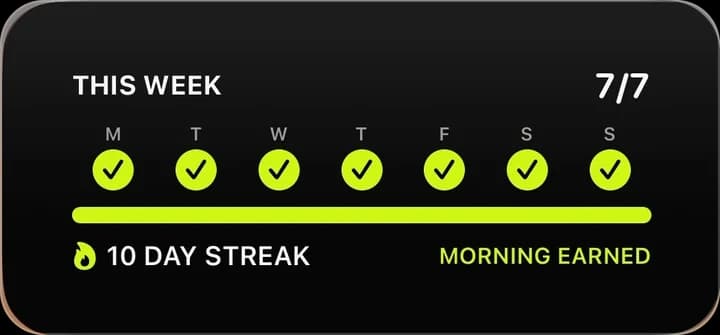
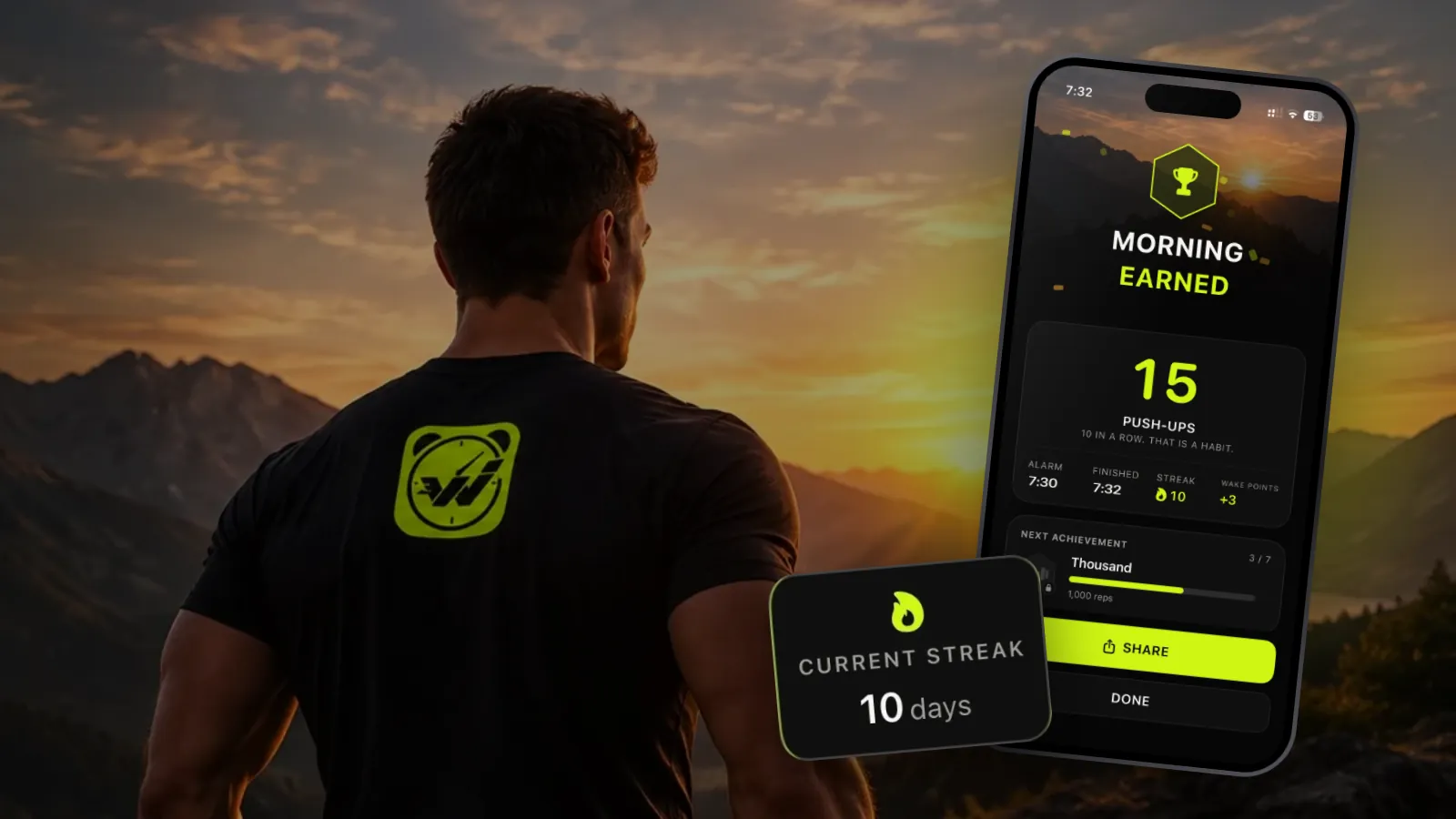
- The count is kept for you. Your streak, the week widget and Woke up on the first ring on your share card.
What Wakeletics can't do is add sleep. If you're snoozing because you're getting five hours a night, start with the first fix, not the seventh.
Sources
Robbins R, Sääf D, Weaver MD, Gradisar M, Quan SF, Czeisler CA. Snooze alarm use in a global population of smartphone users. Scientific Reports. 2025;15:16942. doi:10.1038/s41598-025-99563-y
Sundelin T, Landry S, Axelsson J. Is snoozing losing? Why intermittent morning alarms are used and how they affect sleep, cognition, cortisol, and mood. Journal of Sleep Research. 2024;33(3):e14054. doi:10.1111/jsr.14054
Gollwitzer PM, Sheeran P. Implementation intentions and goal achievement: A meta-analysis of effects and processes. Advances in Experimental Social Psychology. 2006;38:69–119. doi:10.1016/S0065-2601(06)38002-1
Lally P, van Jaarsveld CHM, Potts HWW, Wardle J. How are habits formed: Modelling habit formation in the real world. European Journal of Social Psychology. 2010;40(6):998–1009. doi:10.1002/ejsp.674
Keep reading
All articles →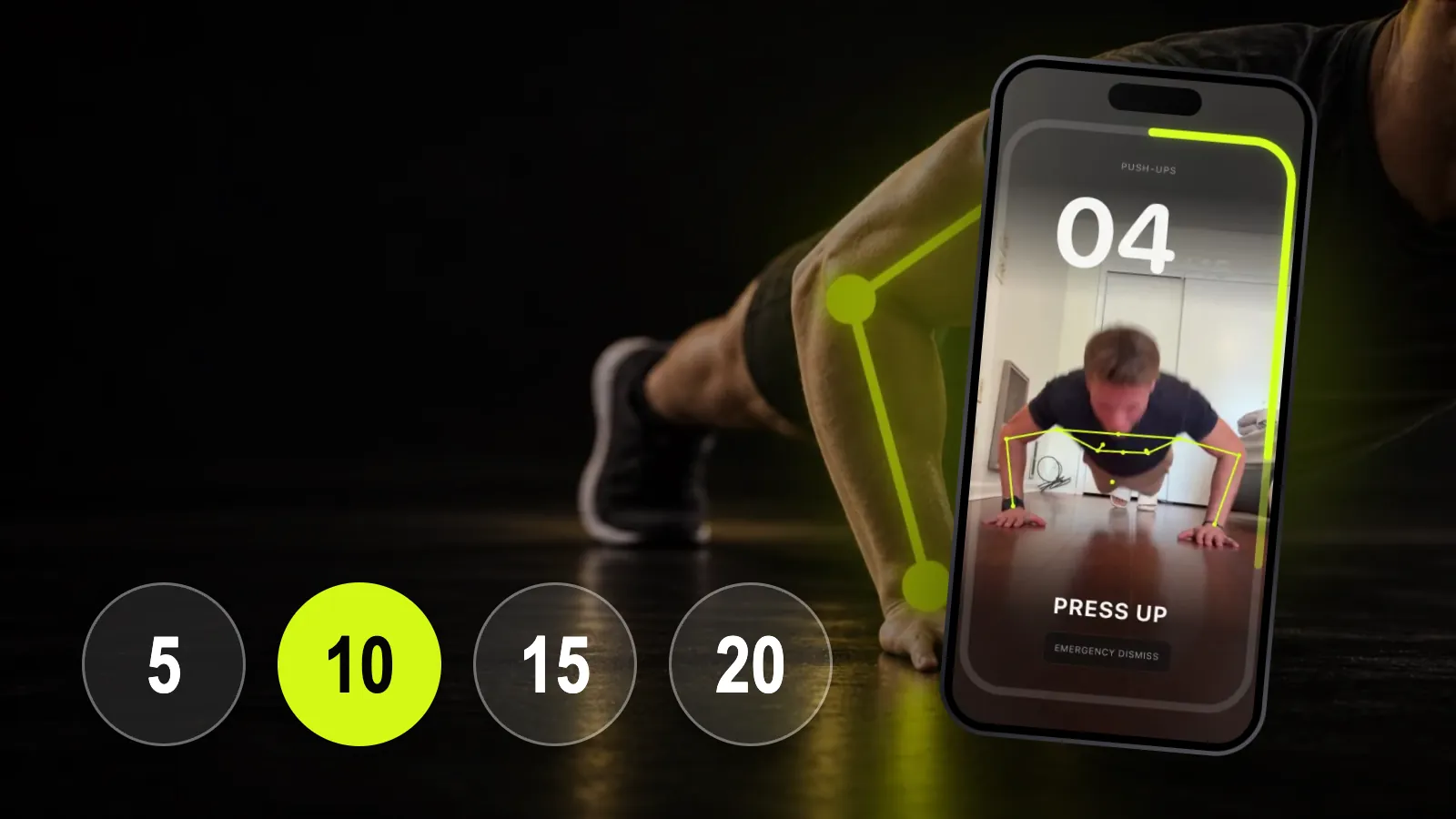 Guides
How many push-ups should I do every morning, and is it OK right after waking?
There's no magic number. Here's how to pick yours, why a wake-up set isn't a workout, what the research says about push-ups and health, and how to look after your back first thing.
4 October 2026 · 7 min read
 Guides
How to get out of bed when your alarm goes off: the first 10 minutes
Nothing makes you sharp the second you wake up, and the research is honest about that. What does help is getting vertical fast. A minute-by-minute plan, with what's evidence and what's just habit.
4 October 2026 · 7 min read
 Guides
I turn off my alarm in my sleep. What can I do?
Why you can silence an alarm and have no memory of it, how common it is, when it's worth asking a doctor, and seven fixes, from the easiest to the strongest.
4 October 2026 · 8 min read
Coming soon to iPhone
A snooze with an end.
Backup rings you choose, and an alarm that only finishes when the reps do. Get up on the first ring, or the third. Either way, you get up.
Not in the App Store yet. wakeletics.app walks you through the whole app.