

Guides
I turn off my alarm in my sleep. What can I do?
Why you can silence an alarm and have no memory of it, how common it is, when it's worth asking a doctor, and seven fixes, from the easiest to the strongest.
By Daniel & Samuel Krucay, co-founders of Wakeletics
· 4 October 2026 · 8 min read
You set the alarm. You're sure it was on. You wake up at 9:40 and the phone shows it rang, and that someone switched it off. That someone was you, and you don't remember any of it.
This is common, it has a fairly simple explanation, and in most cases it's a habit you can change rather than a medical problem. Below: what happens in the minute you can't remember, how to tell a dismissed alarm from one you never heard, and what helps, from the easiest fixes to the strongest.
Why you can switch it off and not remember
Two well-documented things happen at the same time.
You are not fully awake yet. The first minutes after waking have a name, sleep inertia: a real state, measurably different from being awake, with slower reactions and worse thinking. A 2017 review in Sleep Medicine Reviews describes it as some features of sleep carrying on past the moment you wake. It is strongest when you're woken during your biological night, so an alarm that rings earlier than your body expects lands at the worst moment. The full story is in our article on sleep inertia.
Short awakenings often aren't stored as memories. You probably wake several times every night without knowing. In a 2013 study, 39 healthy adults wore movement trackers at home and reported in the morning which awakenings they remembered. On average, an awakening had to last a little over four minutes before people remembered it. The threshold ran from 30 seconds to 10 minutes, depending on the person.
Put those together and the mystery mostly disappears. Reaching over, hitting Stop and rolling back takes a few seconds, and it's a movement you have practised hundreds of times. It needs no real decision and leaves no memory. Your hand did it while your brain was still mostly asleep.
You're far from the only one
A 2025 study in Scientific Reports looked at more than 3 million nights logged in a sleep-tracking app around the world. 55.6% of them ended with the snooze button. On those mornings, people pressed it 2.4 times on average and spent about 11 minutes snoozing. Longer nights, over nine hours, were more likely to end with snoozing, and so were nights when someone went to bed later than usual.
Switching an alarm off completely without remembering is a step further than snoozing, but it starts the same way: the alarm becomes a familiar sound with a familiar off switch.
First: did you dismiss it, or not hear it?
The fixes are different, so check which one it is.
- Your phone shows the alarm was stopped or snoozed, or the alarm list shows it went off, or someone saw you do it: you dismissed it. Everything below is for you.
- Nobody switched it off and it rang the whole time, or someone next to you heard it for minutes: that's not hearing it. Check the alarm volume and whether the alarm was really set for that day. If it was, and you still slept through minutes of ringing, read why some people sleep through their alarm and the doctor section below.
When it's worth talking to a doctor
Most sleepy mornings come from too little sleep, a schedule that fights your body clock, and habit. Some don't. A 2014 study of 19,136 American adults found that 15.2% had episodes of confusional arousal in the past year, meaning they woke up confused or acted strangely and remembered little or nothing of it. In 84% of those people, the episodes went with a sleep disorder, a mental health condition or medication.
Talk to a doctor or a sleep clinic if:
- you regularly do more complicated things you can't remember, such as walking around, talking, sending messages or eating
- you sleep nine hours or more and still can't wake up, or you're very sleepy during the day
- it started with a new medication
- someone has noticed you stop breathing or snore heavily
An app won't fix any of those, and it shouldn't try.
What helps, from easiest to strongest
1. Give yourself enough sleep to wake from
Adults need seven hours or more a night, according to the joint consensus of the American Academy of Sleep Medicine and the Sleep Research Society. If your alarm is set for five and a half hours after you fall asleep, no trick will make it easy. Work back from the wake-up time you need, and protect the bedtime that goes with it.
2. Put the phone out of reach
If your alarm is within arm's reach, you can switch it off half asleep. Charge the phone across the room, or on the floor where you'll stand. Then switching it off means standing up, and standing up is most of the battle.
3. Use one alarm, not a ladder of them
Five alarms ten minutes apart teach you to switch alarms off. The authors of the 2025 study suggest the opposite: set the alarm as late as you realistically can, then get up on the first ring. Ten extra minutes of real sleep is worth more than ten minutes of broken snoozing.
4. Get up at the same time every day
A wake time that moves by hours at the weekend puts your body clock out of step. A Monday alarm then rings during what your body still treats as night, which is exactly when sleep inertia hits hardest. Read why the weekend lie-in has a cost.
5. Decide the first move the night before
If the alarm rings, then I put my feet on the floor. Plans like this have a name: implementation intentions. Across 94 studies they made people noticeably more likely to do what they had planned (Gollwitzer & Sheeran, 2006). None of those studies were about alarms, so treat this as a general principle rather than proof. It costs nothing to try.
6. Get light in the first few minutes
Open the curtains, switch on the main light, or step outside. Bright light early in the day is one of the strongest signals for your body clock. Indoor lighting is much weaker than it seems, as explained in Light sets your clock.
7. Make the off switch something only an awake person can do
This is the step that targets the problem directly. If silencing the alarm takes one familiar tap, your sleeping hand can do it. If it takes something that needs you upright, alert and moving, it can't.
Alarm apps offer different kinds of tasks: maths problems, memory games, scanning a barcode in another room, walking a number of steps, or exercise. One question tells you whether a task will work for you: can you do it lying down? A sum can be solved in bed with your eyes half shut. Push-ups can't.
Where Wakeletics fits
Wakeletics was built for this gap between hearing the alarm and actually getting up.
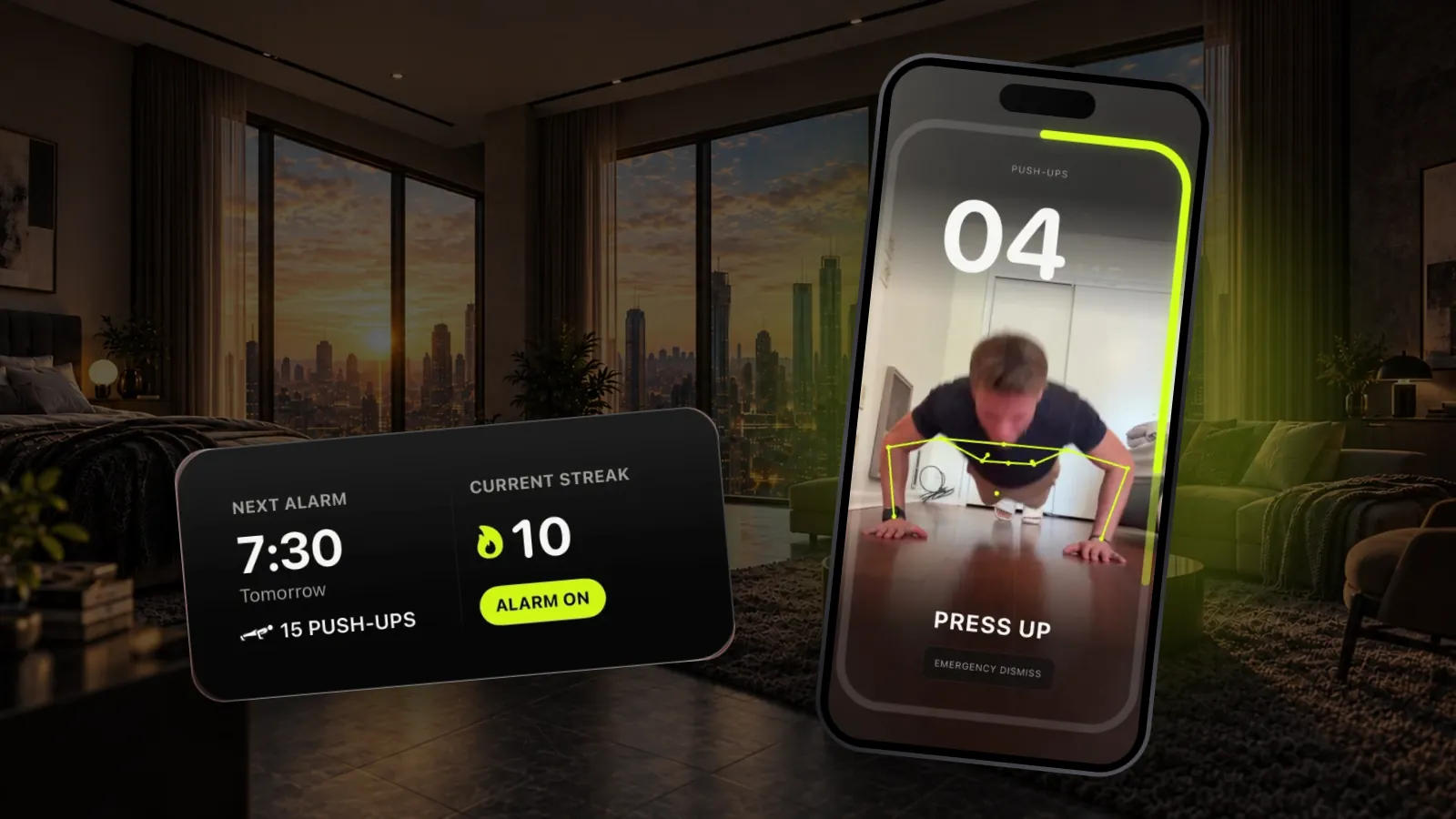
- The alarm ends with reps. You choose push-ups or squats and how many, and the phone's camera counts every full rep. The camera runs on the phone, and no video is recorded or uploaded.
- Silencing one ring doesn't end the morning. iOS always lets you stop a ring from the Lock Screen, for any alarm app. In Wakeletics the next backup ring is then already on its way: two over 5 minutes, four over 15 or six over 25, whichever you chose. The morning counts as earned only when the reps are done.
- You can't get stuck. Emergency Dismiss is always one confirmation away. A morning ended that way just doesn't count toward your streak.
What it won't do is make up for missing sleep, or fix a sleep disorder. If you're sleeping five hours, step 1 matters more than step 7.
The short version
- Switching off an alarm you don't remember is usually sleep inertia plus the fact that short awakenings aren't stored as memories.
- First, sleep enough and keep the same wake time every day.
- Then make the off switch hard to reach and hard to do lying down.
- If it comes with complicated night-time behaviour, very long sleep or heavy daytime sleepiness, talk to a doctor.
Sources
Trotti LM. Waking up is the hardest thing I do all day: Sleep inertia and sleep drunkenness. Sleep Medicine Reviews. 2017;35:76–84. doi:10.1016/j.smrv.2016.08.005
Winser MA, McBean AL, Montgomery-Downs HE. Minimum duration of actigraphy-defined nocturnal awakenings necessary for morning recall. Sleep Medicine. 2013;14(7):688–691. doi:10.1016/j.sleep.2013.03.018
Robbins R, Sääf D, Weaver MD, Gradisar M, Quan SF, Czeisler CA. Snooze alarm use in a global population of smartphone users. Scientific Reports. 2025;15:16942. doi:10.1038/s41598-025-99563-y
Ohayon MM, Mahowald MW, Leger D. Are confusional arousals pathological? Neurology. 2014;83(9):834–841. doi:10.1212/WNL.0000000000000727
Watson NF, et al. Recommended amount of sleep for a healthy adult: a joint consensus statement of the American Academy of Sleep Medicine and Sleep Research Society. Sleep. 2015;38(6):843–844. doi:10.5665/sleep.4716
Gollwitzer PM, Sheeran P. Implementation intentions and goal achievement: A meta-analysis of effects and processes. Advances in Experimental Social Psychology. 2006;38:69–119. doi:10.1016/S0065-2601(06)38002-1
Keep reading
All articles →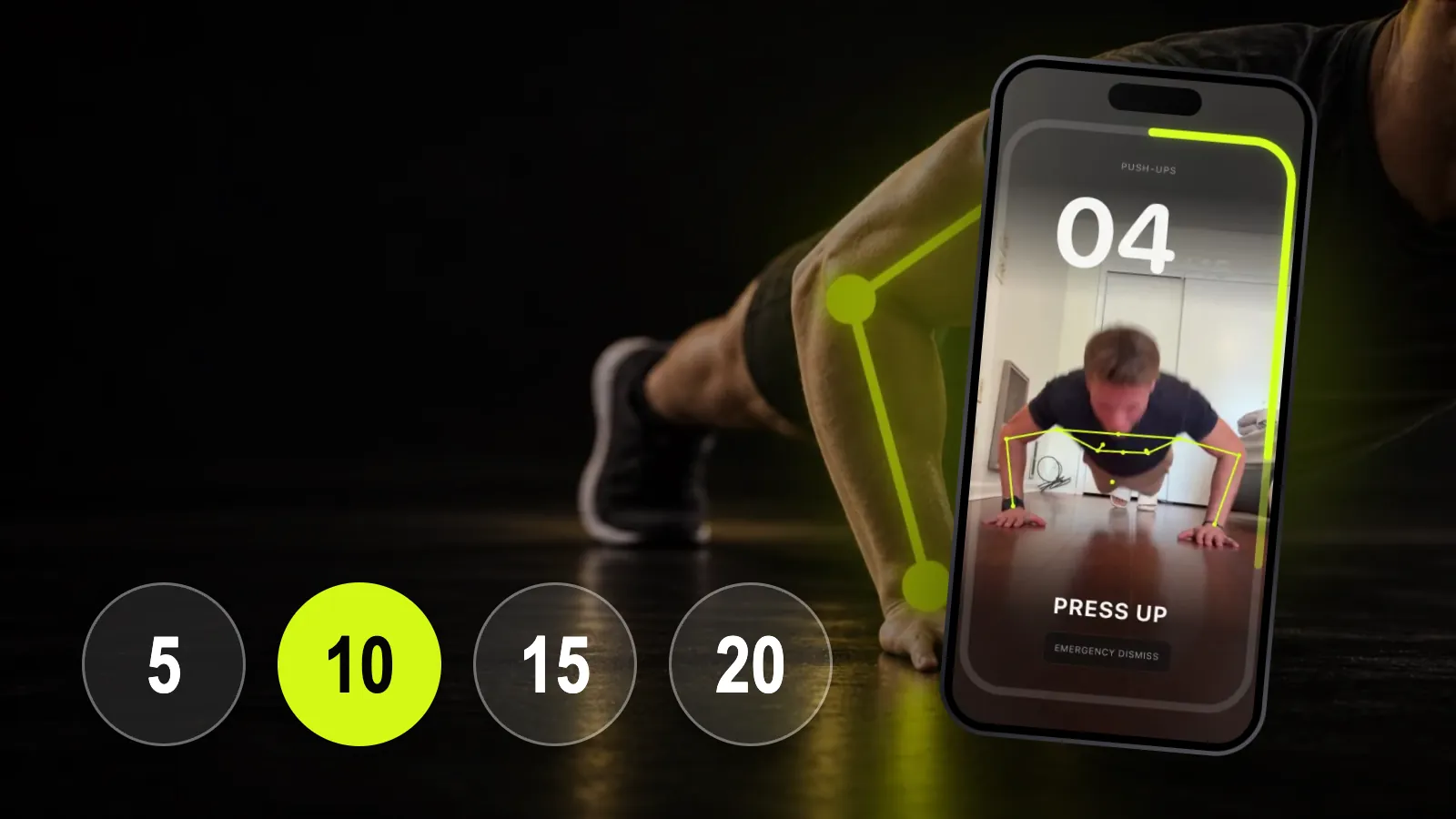 Guides
How many push-ups should I do every morning, and is it OK right after waking?
There's no magic number. Here's how to pick yours, why a wake-up set isn't a workout, what the research says about push-ups and health, and how to look after your back first thing.
4 October 2026 · 7 min read
 Guides
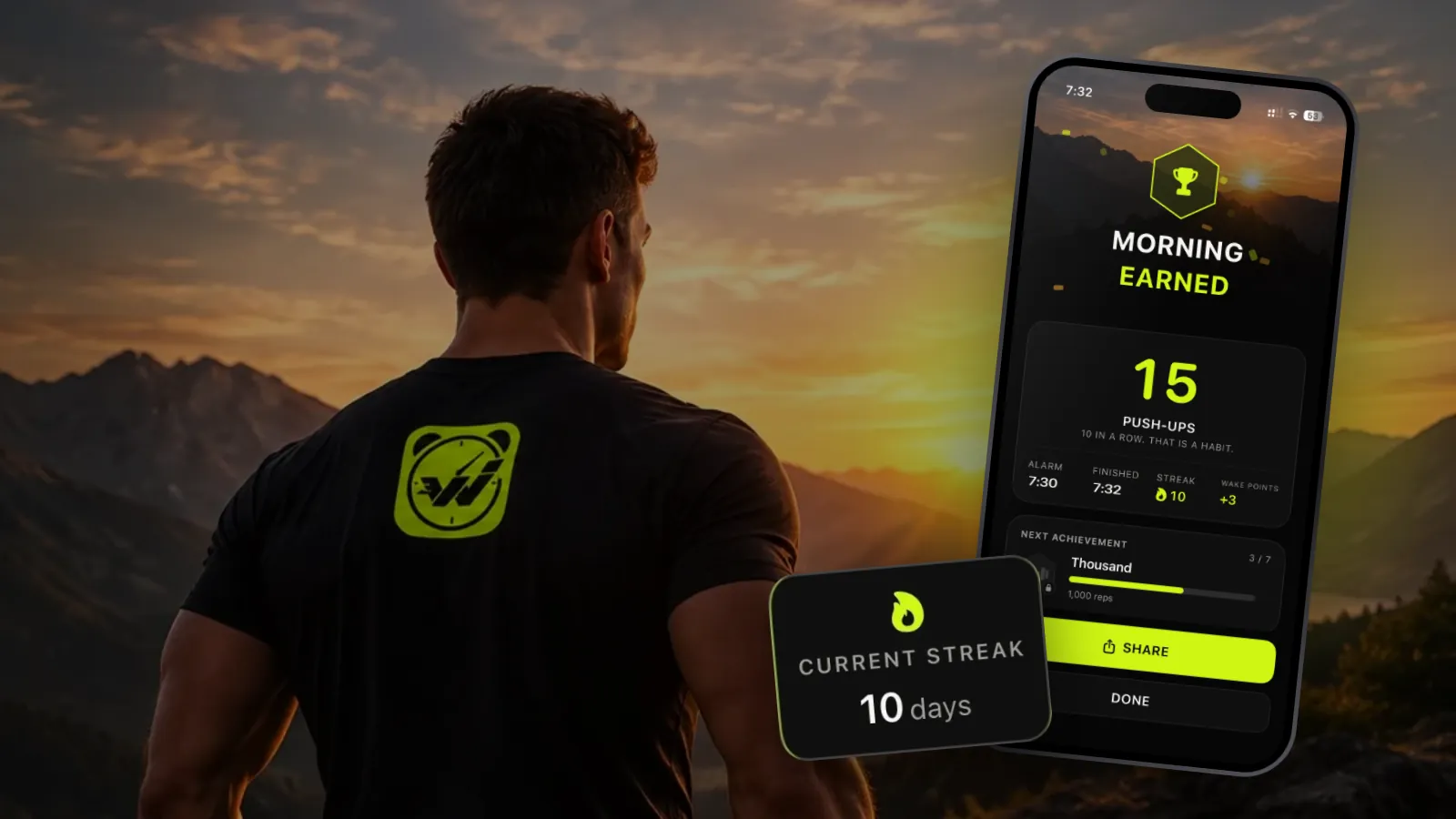
How to get out of bed when your alarm goes off: the first 10 minutes
Nothing makes you sharp the second you wake up, and the research is honest about that. What does help is getting vertical fast. A minute-by-minute plan, with what's evidence and what's just habit.
4 October 2026 · 7 min read
 Guides
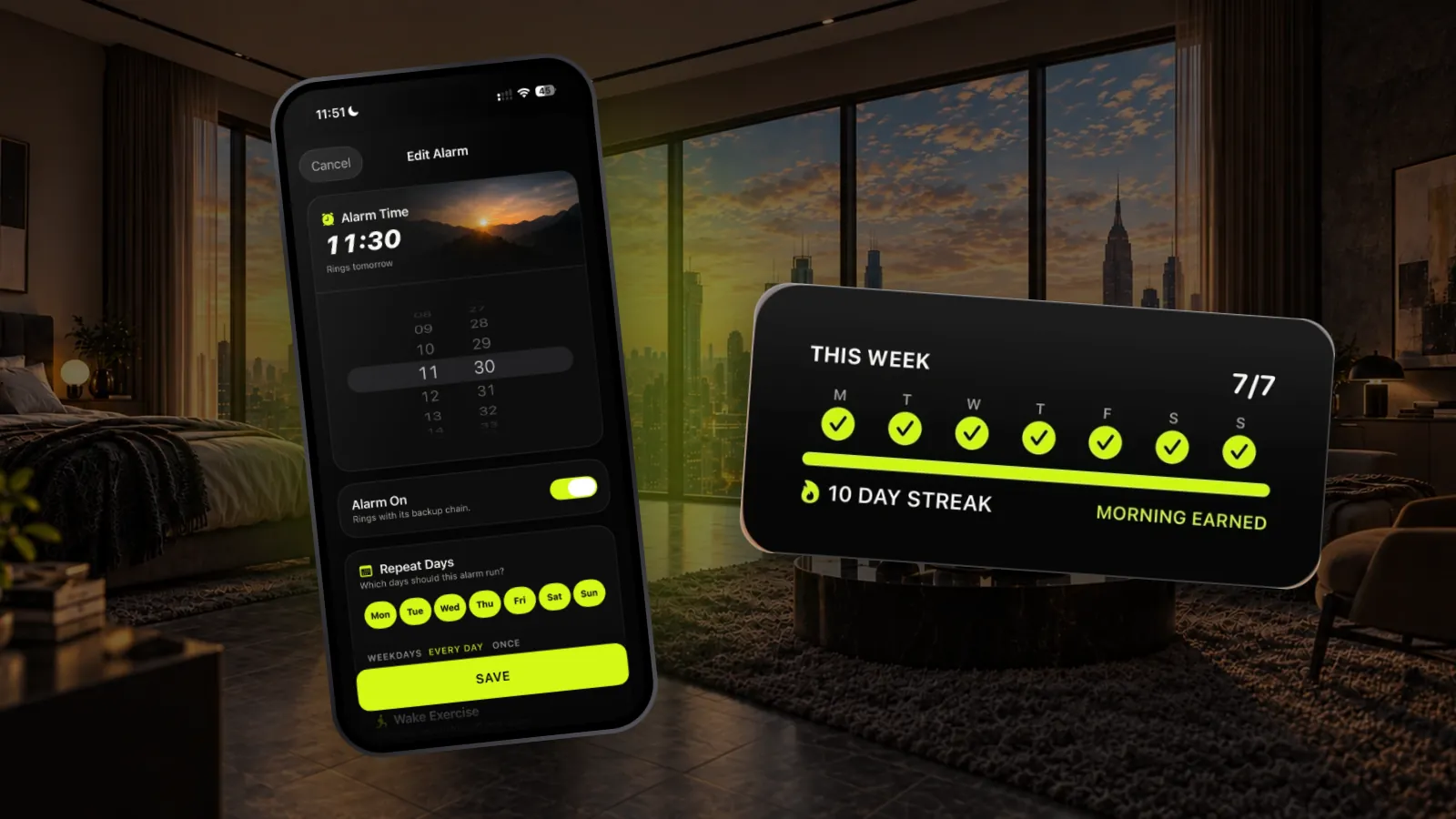
How to stop snoozing your alarm: a 7-day plan
Snoozing itself isn't the enemy. A snooze that never ends is. Here is why the button wins, what helps, and a one-week plan to get up on the first ring.
4 October 2026 · 7 min read
Coming soon to iPhone
Make the off switch need you awake.
A Wakeletics alarm only ends for good once the camera has counted your reps. A thumb half-asleep can silence one ring, but the next ring is already coming.
Not in the App Store yet. wakeletics.app walks you through the whole app.