

Research
Sleep inertia: the half hour where you are not really awake
The grogginess after an alarm is a measurable state with a name. Here is what is known about it, and what is still only a hypothesis.
By Daniel & Samuel Krucay, co-founders of Wakeletics
· 22 August 2026 · Updated 4 October 2026 · 7 min read
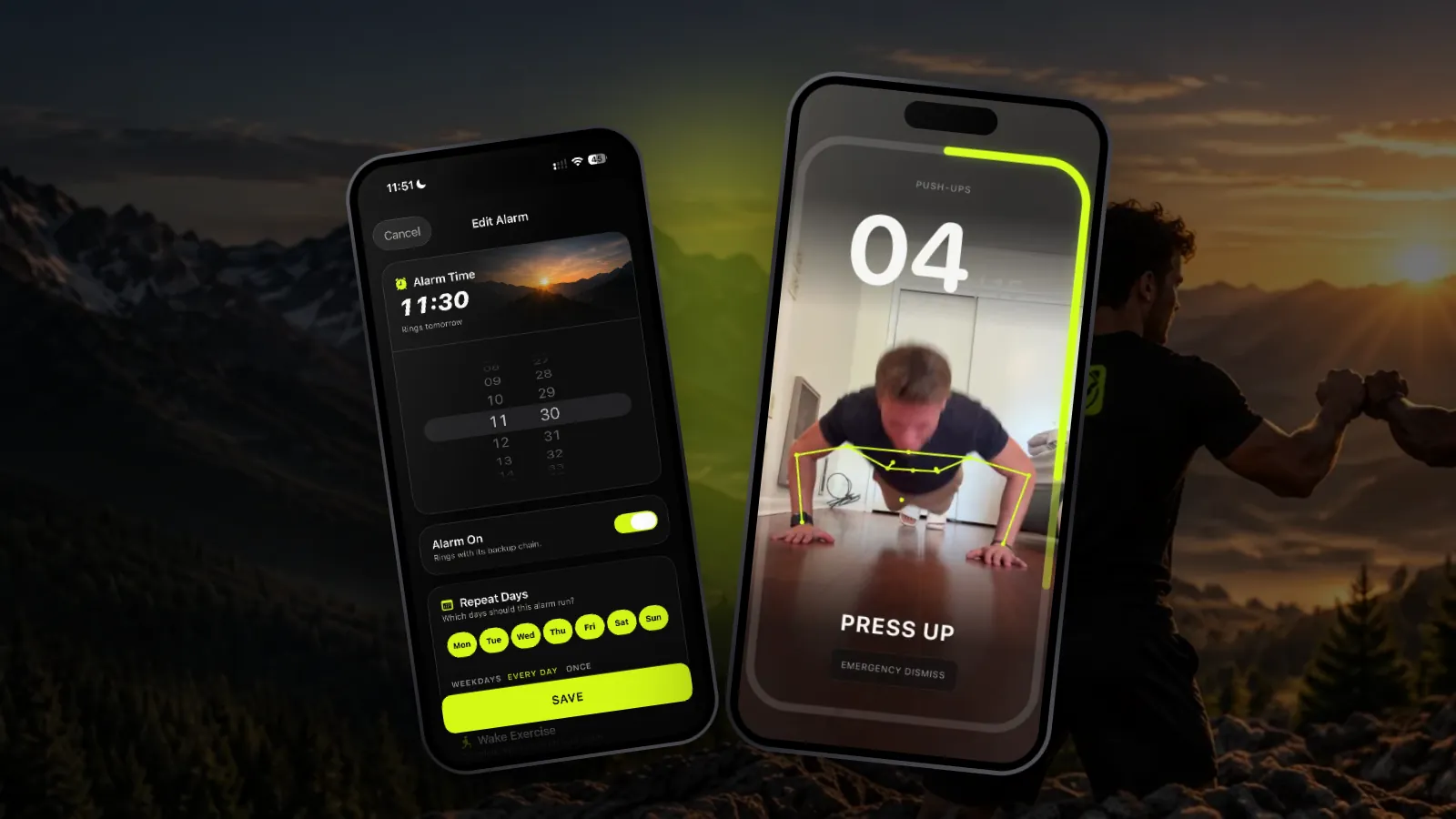
The moment after an alarm is not a mood. It is a documented physiological state called sleep inertia, and it is the reason decisions made in the first few minutes of a day are so reliably terrible.
What it actually is
Sleep inertia is the transitional period between waking and being fully functional. During it, alertness is reduced and cognitive performance is measurably impaired — reaction time, working memory, arithmetic, decision quality. It is not subtle. It is studied seriously in aviation, medicine and emergency services precisely because people in those jobs are sometimes woken and expected to make consequential decisions within minutes.
Performance is typically impaired for a meaningful stretch after waking, and the effect is worse when you are woken out of deep, slow-wave sleep rather than lighter sleep. Which is why the same seven hours can produce two completely different mornings depending on where in a cycle the alarm lands.
The practical consequence: the version of you that decides whether to get up is cognitively impaired, and it is deciding about the whole day. That is a bad committee to leave in charge.
Where exercise comes in — carefully
Here is where most articles would tell you that morning exercise cures sleep inertia. The honest answer is more interesting.
In 2020, Kovac and colleagues published a paper in Frontiers in Physiology asking exactly this question. They laid out a plausible mechanism: exercise on waking should stimulate the same three processes that the body ramps up naturally during a normal awakening —
- increased cerebral blood flow
- the cortisol awakening response
- a rise in core body temperature
All three track with the dissipation of sleep inertia. Raising them deliberately, faster, is a reasonable thing to expect might help.
But the paper is a hypothesis and theory review, not an experiment, and the authors are unusually direct about it. In their words, exercise "has not yet been investigated as a sleep inertia countermeasure." They call for research on intensity, minimum effective duration, and how it holds up under different sleep conditions — before anyone makes recommendations.
So: a well-argued mechanism, published in a peer-reviewed journal, explicitly awaiting a trial. That is not the same as proof, and we are not going to dress it up as one.
Since then, the trial has been run. The same group woke 15 people at 2 AM and had them do 30 seconds on an exercise bike, hard or easy, or nothing. After the hard sprint, people felt less sleepy. Their thinking tests were no better than when they stayed still (Kovac et al., 2021). So exercise on waking makes you feel more awake, which is most of what getting out of bed needs. It doesn't yet look like it makes you sharper. More on using that in the first ten minutes after the alarm.
What is better established
Two things are on firmer ground than the exercise hypothesis:
Deep sleep makes it worse. Being woken from slow-wave sleep produces more severe inertia than being woken from lighter stages. Part of why some mornings feel unsurvivable is simply where the alarm landed.
Time is the reliable cure. The impairment fades. It just fades on its own schedule, which is inconveniently long if you have somewhere to be — and which you spend lying down, negotiating.
Why this shapes how Wakeletics works
If the first half hour is when your judgement is worst, then the design goal is obvious: remove the judgement.
Wakeletics does not ask an impaired brain to decide whether today is a good day to get up. It replaces the decision with a condition — ten push-ups, verified — and lets the impaired brain simply comply, which it is far better at than deciding. Whether the movement itself accelerates the fog clearing is a genuinely open question. That you are standing up, rather than lying down re-litigating your alarm, is not.
Sources
Kovac K, Vincent GE, Paterson JL, Reynolds A, Aisbett B, Hilditch CJ, Ferguson SA. The impact of a short burst of exercise on sleep inertia. Physiology & Behavior. 2021;242:113617. doi:10.1016/j.physbeh.2021.113617
Kovac K, Ferguson SA, Paterson JL, Aisbett B, Hilditch CJ, Reynolds AC, Vincent GE. Exercising Caution Upon Waking — Can Exercise Reduce Sleep Inertia? Frontiers in Physiology. 2020;11:254. doi:10.3389/fphys.2020.00254
Sundelin T, Landry S, Axelsson J. Is snoozing losing? Why intermittent morning alarms are used and how they affect sleep, cognition, cortisol, and mood. Journal of Sleep Research. 2024;33(3):e14054. doi:10.1111/jsr.14054
Keep reading
All articles → Research
Your alarm sets your schedule. Light sets your clock.
An alarm decides when you open your eyes. What decides whether your body agrees is the light you get in the following hour — and indoor lighting barely registers.
27 August 2026 · 6 min read
 Research
The weekend lie-in has a name, and a cost
About 70% of working people carry a permanent two-hour time-zone shift between their weekdays and weekends. Chronobiologists call it social jetlag.
26 August 2026 · 7 min read
 Research
How long until a morning workout stops being a decision?
Not 21 days. The real study found a median of 66 — and a range wide enough to explain why most habit advice fails you.
25 August 2026 · 6 min read
Coming soon to iPhone
Decide tonight. Just move tomorrow.
Set the time, the exercise and the number while you can still think. When the alarm rings, the only job left is the reps.
Not in the App Store yet. wakeletics.app walks you through the whole app.