

Research
How long until a morning workout stops being a decision?
Not 21 days. The real study found a median of 66 — and a range wide enough to explain why most habit advice fails you.
By Daniel & Samuel Krucay, co-founders of Wakeletics
· 25 August 2026 · 6 min read

The "21 days to build a habit" figure is one of the most repeated numbers in self-improvement, and it comes from no habit study at all. It is a misreading of a 1960s plastic surgeon's observation about how long patients took to adjust to their new appearance.
The real research is less catchy and far more useful.
The study that actually measured it
In 2010, Phillippa Lally and colleagues at University College London published How are habits formed: Modelling habit formation in the real world in the European Journal of Social Psychology.
96 volunteers each picked one eating, drinking or activity behaviour to perform daily, in the same context — the key phrase being "after breakfast," "when I get home," a specific recurring cue. They logged it every day for 12 weeks and rated how automatic it felt.
The researchers then fitted a curve to each person's automaticity scores and asked: how long until this behaviour plateaus into something that runs without deliberate effort?
The numbers
Median: 66 days. Roughly three times the folklore figure.
But the median is the least interesting number in the paper. The range was 18 to 254 days. And automaticity plateaued within the study window for only about half of participants — for the rest, twelve weeks was simply not long enough to finish the job.
Two things follow from that spread, and both matter more than the headline:
Simple behaviours automate faster than complex ones. Drinking a glass of water after breakfast consolidates quickly. Something demanding — getting out of bed and exercising — sits at the slow end. Expecting a morning workout to feel effortless in three weeks is planning to be disappointed on day 22.
A missed day is not a reset. This is the finding people most need and least hear. Occasional lapses did not measurably damage the habit-formation process. The all-or-nothing framing — "I broke the chain, the streak is dead, why bother" — has no support in the data. Missing Wednesday does not undo three weeks.
What actually drove it
Repetition in response to a consistent cue. Not motivation, not intensity, not tracking apps. Doing the same thing after the same reliable trigger, enough times.
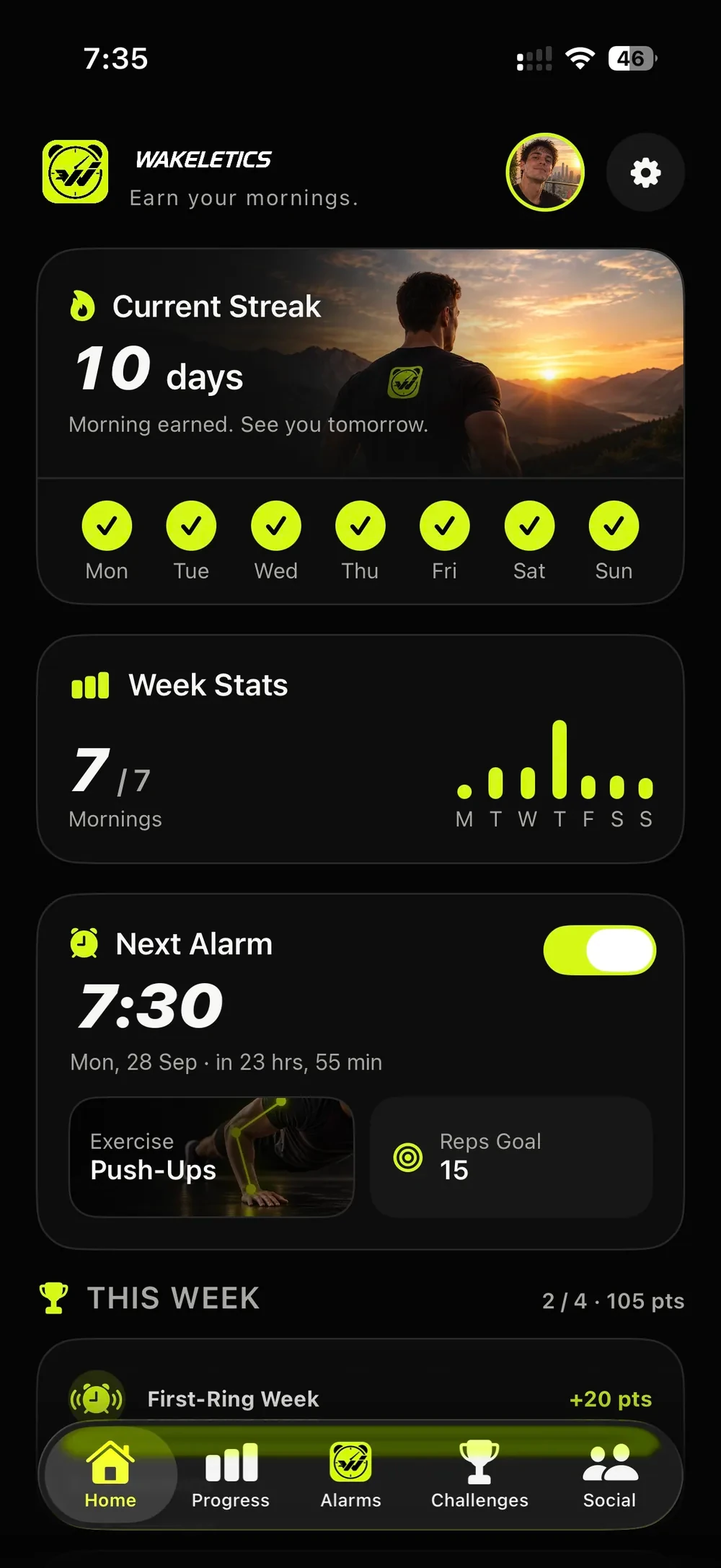
An alarm is close to a perfect cue. It fires at the same time, in the same place, without needing you to remember anything, on days when you feel like it and days when you do not. That is the exact structure the research says builds automaticity — which is a large part of why we built this around an alarm rather than a workout planner.
The honest expectation to set
If you start tomorrow, here is a realistic picture rather than a motivational one:
- Weeks 1–2: entirely deliberate. Every single morning is a decision you have to win.
- Weeks 3–6: the point where "21 days" promised transformation and does not deliver. This is where most people quit, on schedule, believing they failed.
- Around two months: for many people, the resistance starts thinning. Not gone. Thinner.
- Some people: considerably longer. Two hundred days is inside the observed range, not evidence you are broken.
 1 morning
 50 mornings
 100 mornings
The point of a verified streak is not to shame you on the days you miss. It is to keep the count honest across a window that is much longer than anyone tells you, so that on day 40 — when it still feels hard, and you assume that means it is not working — you have evidence that it is.
Source
Lally P, van Jaarsveld CHM, Potts HWW, Wardle J. How are habits formed: Modelling habit formation in the real world. European Journal of Social Psychology. 2010;40(6):998–1009. doi:10.1002/ejsp.674
Keep reading
All articles → Research
Your alarm sets your schedule. Light sets your clock.
An alarm decides when you open your eyes. What decides whether your body agrees is the light you get in the following hour — and indoor lighting barely registers.
27 August 2026 · 6 min read
 Research
The weekend lie-in has a name, and a cost
About 70% of working people carry a permanent two-hour time-zone shift between their weekdays and weekends. Chronobiologists call it social jetlag.
26 August 2026 · 7 min read
 Research
Is the snooze button actually bad for you?
A 2024 sleep-lab study put habitual snoozers on polysomnography and tested them. The result is not what wake-up apps usually claim.
24 August 2026 · 6 min read
Coming soon to iPhone
Day 40 still counts.
An alarm is the steady cue habits are built on. Wakeletics adds verified reps and an honest count, so you can see it working before it feels like it.
Not in the App Store yet. wakeletics.app walks you through the whole app.