

Research
Is the snooze button actually bad for you?
A 2024 sleep-lab study put habitual snoozers on polysomnography and tested them. The result is not what wake-up apps usually claim.
By Daniel & Samuel Krucay, co-founders of Wakeletics
· 24 August 2026 · 6 min read
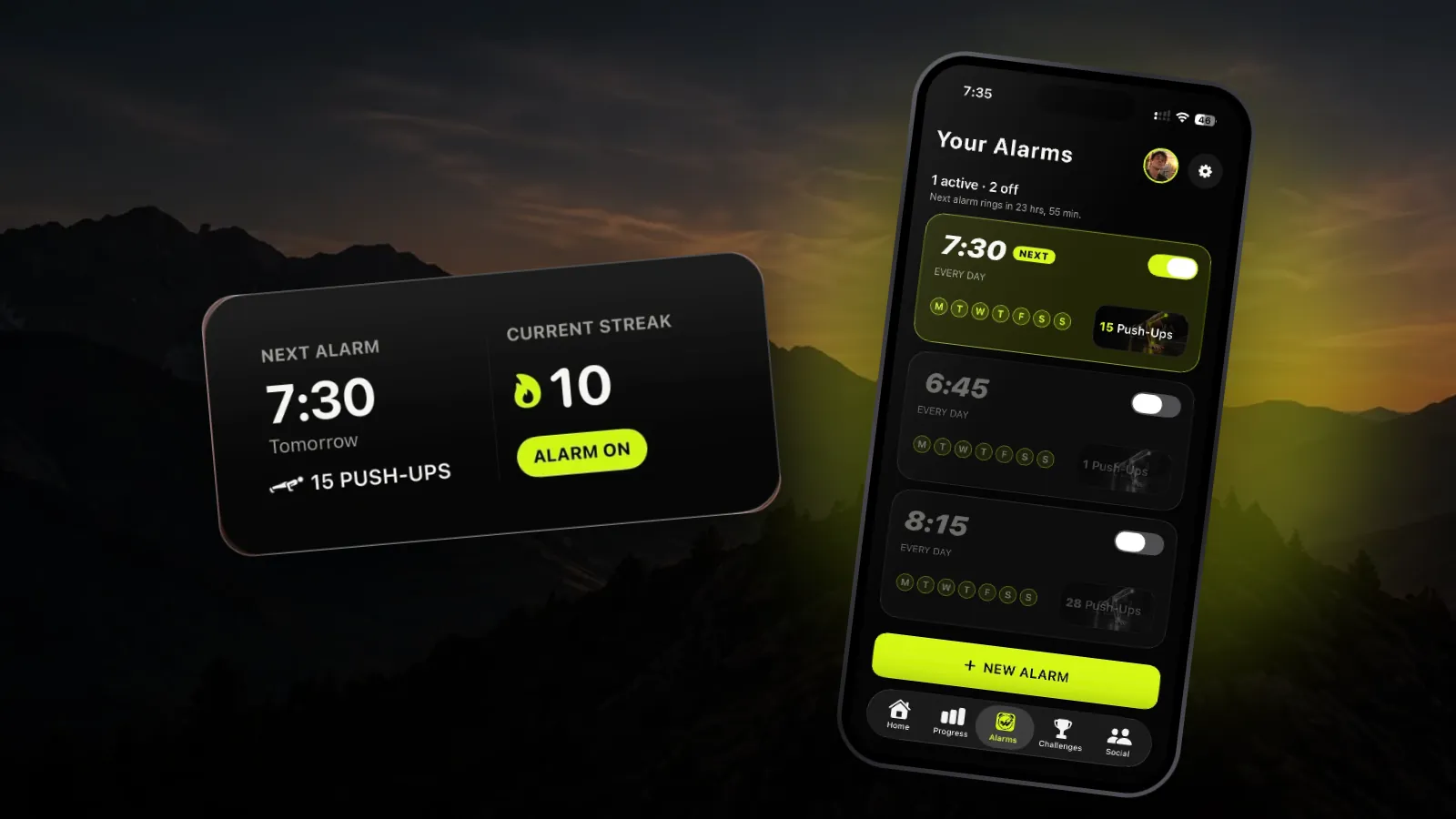
We build an app whose entire premise is that you should get up. So it would be convenient for us if the science said the snooze button was ruining your brain.
It does not, and pretending otherwise would be the fastest way to lose your trust.
What the study did
In 2024, Tina Sundelin, Shane Landry and John Axelsson published Is snoozing losing? in the Journal of Sleep Research. The interesting part is the second study: 31 habitual snoozers, in a sleep laboratory, on polysomnography — actual electrode-measured sleep staging, not a self-report survey. Each person was tested both ways: 30 minutes of snoozing, and an abrupt single-alarm awakening.
Then they measured cognition immediately on rising.
What they found
Thirty minutes of snoozing improved or did not affect cognitive performance directly upon getting up, compared with waking abruptly to a single alarm.
Not "was slightly less bad." Improved or neutral. The proposed explanation is straightforward: those extra fragmented minutes make it less likely that your final awakening happens out of deep slow-wave sleep, which is the kind of awakening that produces the worst sleep inertia. Snoozing, in effect, lets you surface from a lighter stage.
The study did find that snoozing costs you a small amount of sleep in those last thirty minutes. But it did not find the cognitive penalty that popular advice has assumed for years.
So what is the actual problem?
Not the button. The problem is the mornings where the snooze cycle does not terminate.
There is a version of snoozing that is nine extra minutes and then you get up. The study looked at roughly that, and found it benign. Then there is the version where the alarm becomes background noise, thirty minutes becomes seventy, and the workout you planned quietly stops existing. That is not a sleep-architecture problem. It is a commitment problem, and no amount of sleep science will solve it, because it is not a sleep question.
What this means for how we talk about Wakeletics
It would be easy to market this app as "kills the snooze button, backed by science." We are not going to, because the sentence is false in the direction that matters.
What Wakeletics actually does is narrower and defensible: it makes the end of the morning verifiable. Snooze for nine minutes if you like — the evidence says it may even help you land on a lighter sleep stage. What the app removes is the option to never finish. The morning is not earned until reps happen, and no amount of negotiating with yourself changes that number.
That is a claim about accountability, not about sleep physiology. We would rather make one true claim than three impressive ones.
Source
Sundelin T, Landry S, Axelsson J. Is snoozing losing? Why intermittent morning alarms are used and how they affect sleep, cognition, cortisol, and mood. Journal of Sleep Research. 2024;33(3):e14054. doi:10.1111/jsr.14054
Keep reading
All articles → Research
Your alarm sets your schedule. Light sets your clock.
An alarm decides when you open your eyes. What decides whether your body agrees is the light you get in the following hour — and indoor lighting barely registers.
27 August 2026 · 6 min read
 Research
The weekend lie-in has a name, and a cost
About 70% of working people carry a permanent two-hour time-zone shift between their weekdays and weekends. Chronobiologists call it social jetlag.
26 August 2026 · 7 min read
 Research
How long until a morning workout stops being a decision?
Not 21 days. The real study found a median of 66 — and a range wide enough to explain why most habit advice fails you.
25 August 2026 · 6 min read
Coming soon to iPhone
Snooze if you must. Then earn it.
Wakeletics doesn't fight the snooze button. Silence the ring early and the next one is already coming — it only stops for good once the camera has counted your reps.
Not in the App Store yet. wakeletics.app walks you through the whole app.