

Guides
How many push-ups should I do every morning, and is it OK right after waking?
There's no magic number. Here's how to pick yours, why a wake-up set isn't a workout, what the research says about push-ups and health, and how to look after your back first thing.
By Daniel & Samuel Krucay, co-founders of Wakeletics
· 4 October 2026 · 7 min read
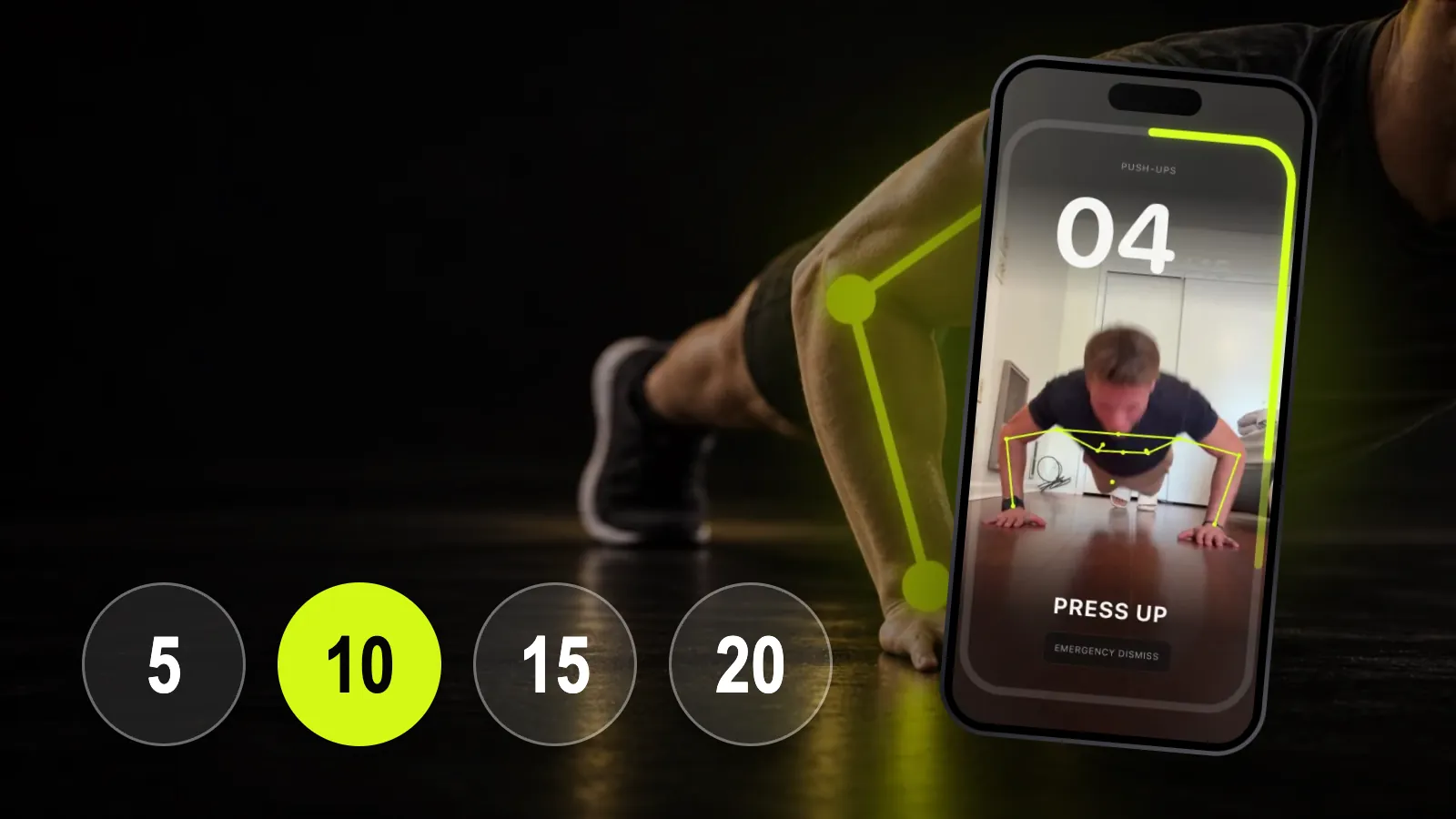
Ten push-ups every morning. Fifty. A hundred. The internet has a number for everyone. The honest answer is that there isn't a right number, but there's a good way to choose yours, and a few things worth knowing about doing them straight out of bed.
The short answer
Pick a number you can do with good form on your worst morning, not your best. For most people who don't train, that's 5 to 10 push-ups. For people who do, 15 to 20. Do them every morning, and add a few reps every week or two once the set feels easy.
Right after waking is fine for most healthy people, as long as you start gently and keep your back straight. If you have a heart condition, a recent injury or back problems, check with a doctor first.
A wake-up set is not a workout
It helps to be clear about what the morning set is for. Its job is to get you up, moving and awake. It isn't meant to build muscle on its own, and it doesn't have to.
The WHO's guidelines for adults recommend muscle-strengthening activity at moderate or greater intensity, involving all major muscle groups, on two or more days a week (Bull et al., 2020). A morning set of ten push-ups works some of those muscles, but not all of them, and usually not hard enough to count as a full session.
That doesn't make it pointless. A 2022 review of 16 long-term studies found that people who did muscle-strengthening activity had a 10 to 17% lower risk of dying early and of heart disease, cancer and diabetes. The biggest difference appeared at around 30 to 60 minutes a week, and doing much more didn't clearly add to it (Momma et al., 2022). These studies show a link, not proof that strength training causes the difference. Still, a minute or two every morning is a real part of an hour a week, and it's the part you never have to schedule.
How to choose your number
Your number should feel easy. Think of it as a commitment you can keep on the morning after a bad night's sleep, not as a test. If the last two reps are a struggle, it's too many for 6 AM.
A rough guide:
- Can't do a full push-up yet: set your alarm to squats while you build up push-ups at another time of day. Wall push-ups and push-ups with your hands on a table are good ways in.
- New to it: 5 to 10 push-ups, or 10 to 15 squats.
- Already train: 15 to 20 push-ups, or 20 to 30 squats.
- Want more: add a second alarm later in the day rather than turning the morning into a long session.
Form before numbers
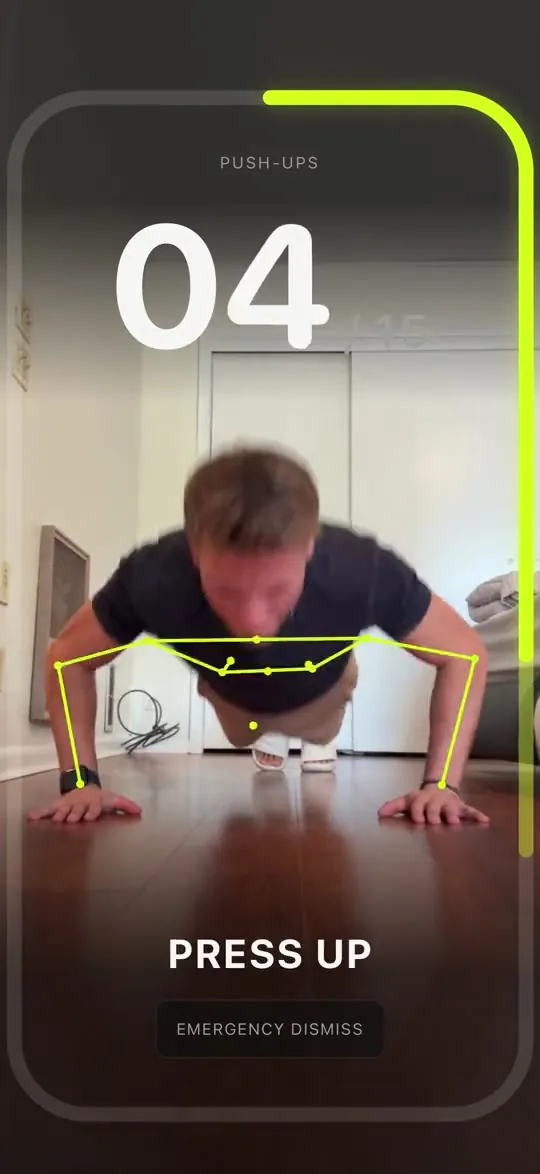
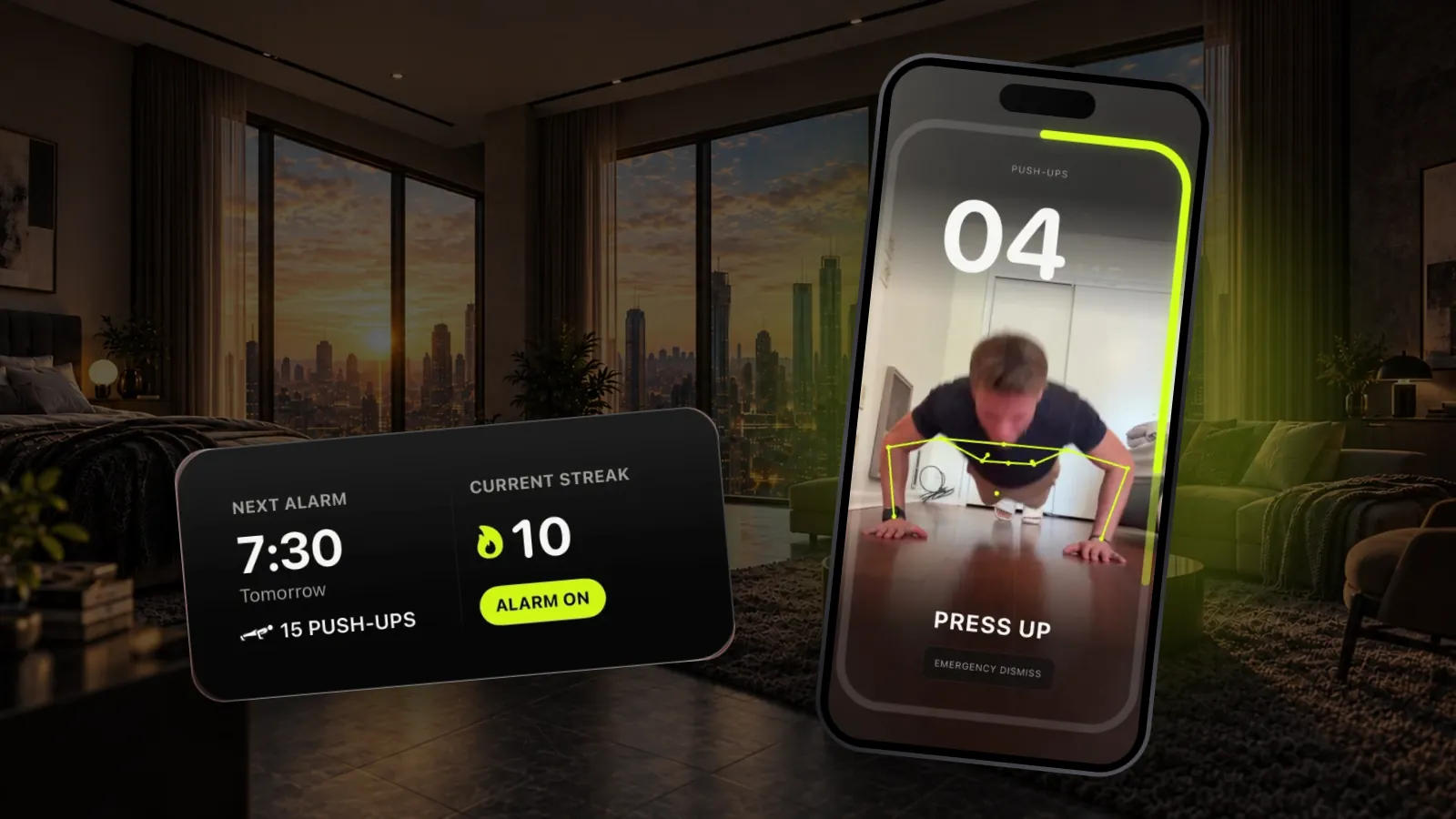
Five full push-ups do more than fifteen half ones. Keep your body straight from head to heels, lower your chest until it's close to the floor, and push back up until your arms are straight. In Wakeletics, the camera counts a push-up only when your arms bend far enough and then straighten again, so half reps don't count anyway.
How to add more
Once your number feels easy for a week or two, add a few reps. Small steps hold up better than big jumps. If you use Wakeletics, the weekly challenges sometimes include Personal Best (beat your best single session) and, with Pro, Rep Ladder (three sessions, each bigger than the last). They're a good excuse to move your number up.
What about the "40 push-ups" study?
You may have seen headlines saying that being able to do 40 push-ups predicts a healthier heart. The study behind them followed 1,104 male firefighters for ten years. Those who could do more than 40 push-ups at the start had far fewer heart problems than those who could do fewer than 10 (Yang et al., 2019).
It's an interesting result, but read it carefully. The participants were active men with an average age of about 40, and the study measured how many push-ups they could do, as a sign of overall fitness. It didn't test whether doing 40 push-ups a day makes your heart healthier. The authors themselves said larger studies in more diverse groups are needed. So treat 40 as a fitness marker, not as a daily target.
Is it OK to do push-ups right after waking?
For most healthy adults, yes. A short set of bodyweight exercise isn't a big demand on the body. There are a few things worth knowing, though.
You'll feel more awake, not instantly sharper. In a 2021 lab study, people woken at 2 AM who did 30 seconds of hard exercise felt less sleepy afterwards than when they stayed still. Their thinking tests didn't improve (Kovac et al., 2021). So the set helps you get going. It won't make you ready for a hard decision a minute later.
Your back is different first thing. After a night lying down, the discs in your lower back hold more water. A classic study found that bending forward puts noticeably more stress on them in the early morning than later in the day (Adams et al., 1987). In a trial with people who had long-term lower back pain, those who were taught to avoid bending forward early in the morning reported clearly less pain. The comparison group, given exercises known not to help, saw no significant change (Snook et al., 1998).
The practical point: a push-up done well keeps your back straight, like a plank, so it isn't the problem. Touching your toes as your first stretch of the day might be. If your back is sensitive, skip the forward bends in the first half hour and keep your squats upright, with your chest up.
A 30-second warm-up doesn't hurt. A few arm circles, a few slow squats, a short walk to the light switch. There's no strong evidence that this prevents injury in a set this short, but it makes the first reps feel less stiff. Our habit, not research.
Check with a doctor first if
- you have a heart condition, high blood pressure that isn't under control, or have ever had chest pain or fainted during exercise
- you've recently had surgery, an injury, or a back or shoulder problem
- you're pregnant or have recently given birth
- you get dizzy when you stand up quickly
Where Wakeletics fits
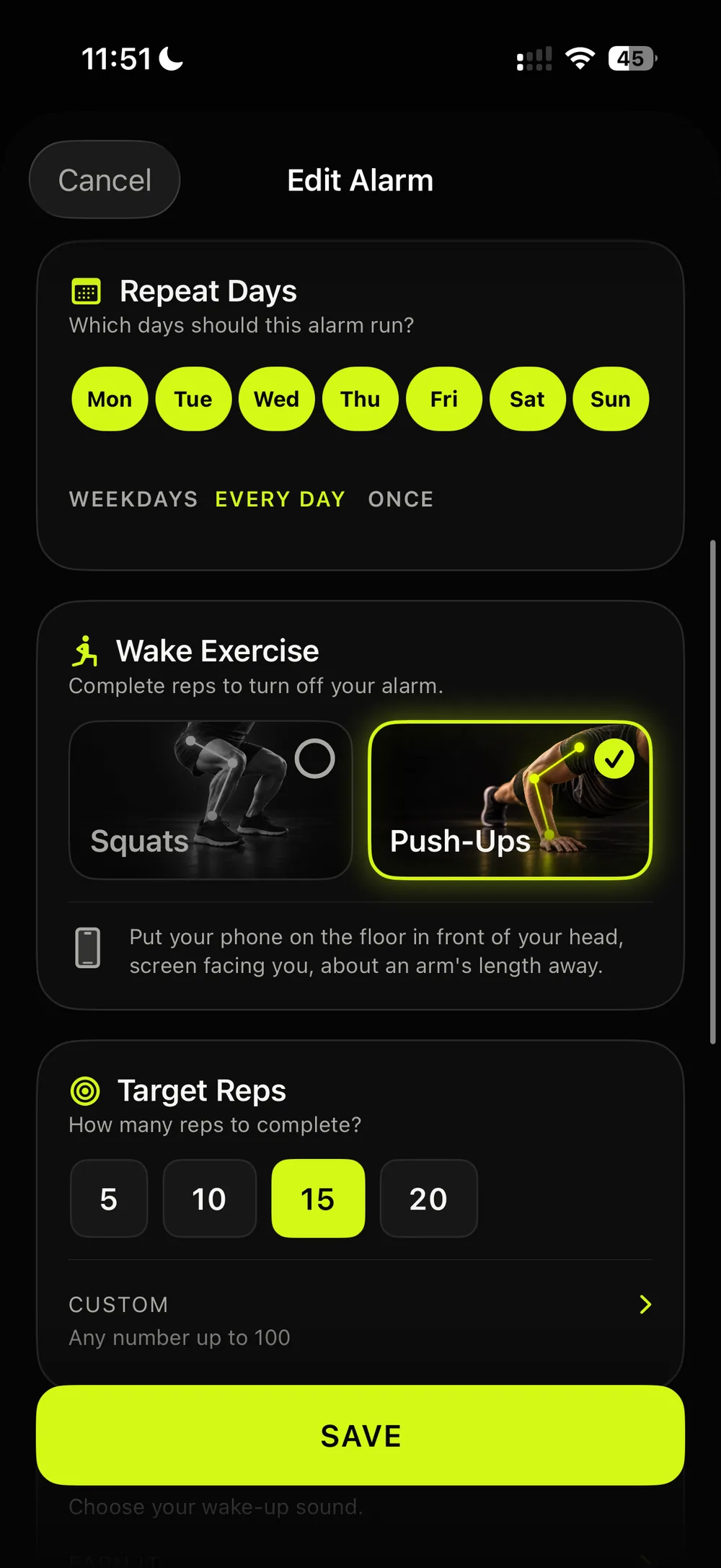
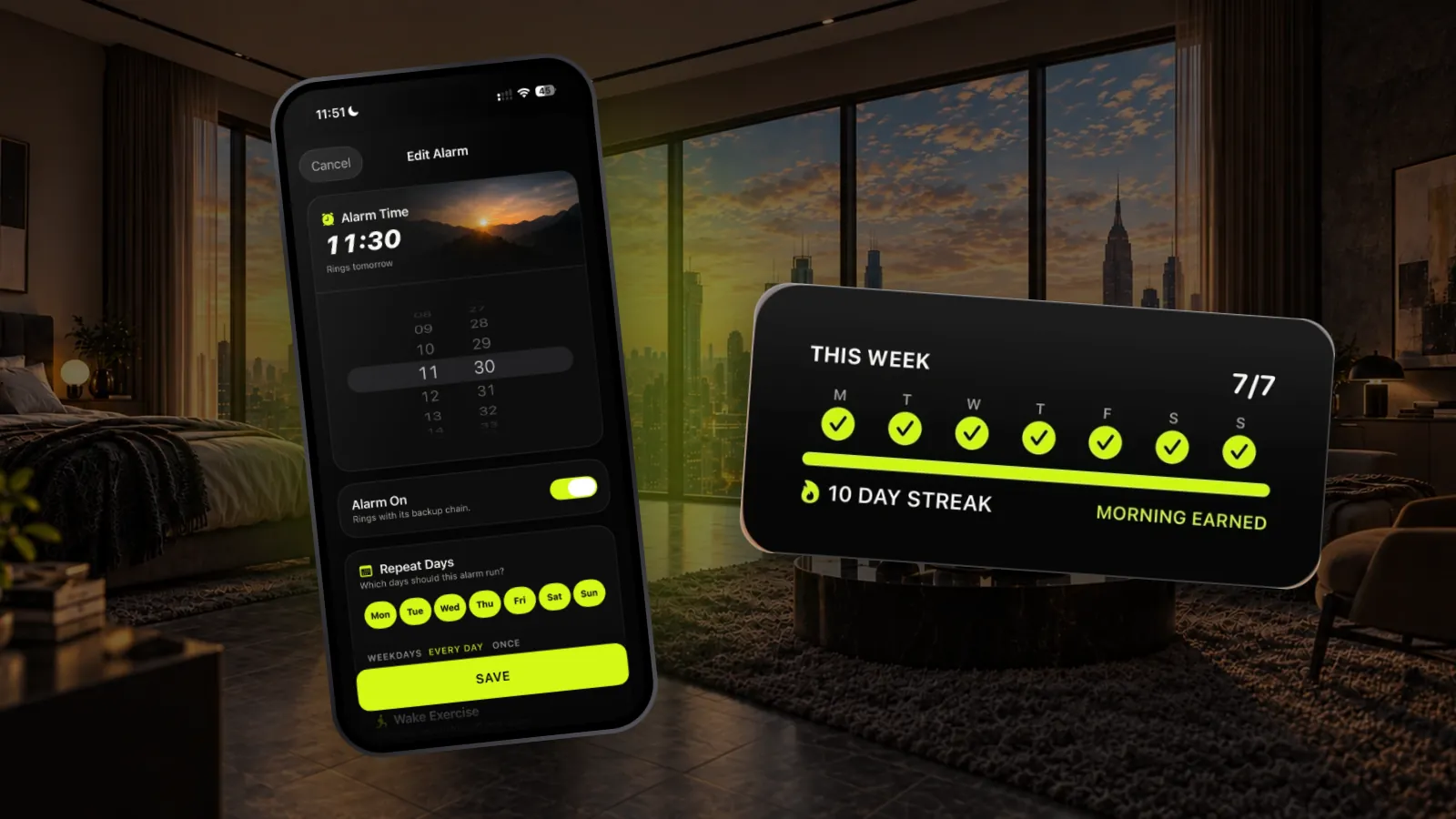
When you set a Wakeletics alarm, you choose the exercise and the number:
- Push-ups: 5, 10, 15 or 20, with 10 suggested.
- Squats: 10, 15, 20 or 30, with 15 suggested.
- Custom: any number from 1 to 100. The limit is deliberate: past about a hundred, a wake-up set turns into a workout, and a workout is something people start switching their alarm off to avoid.
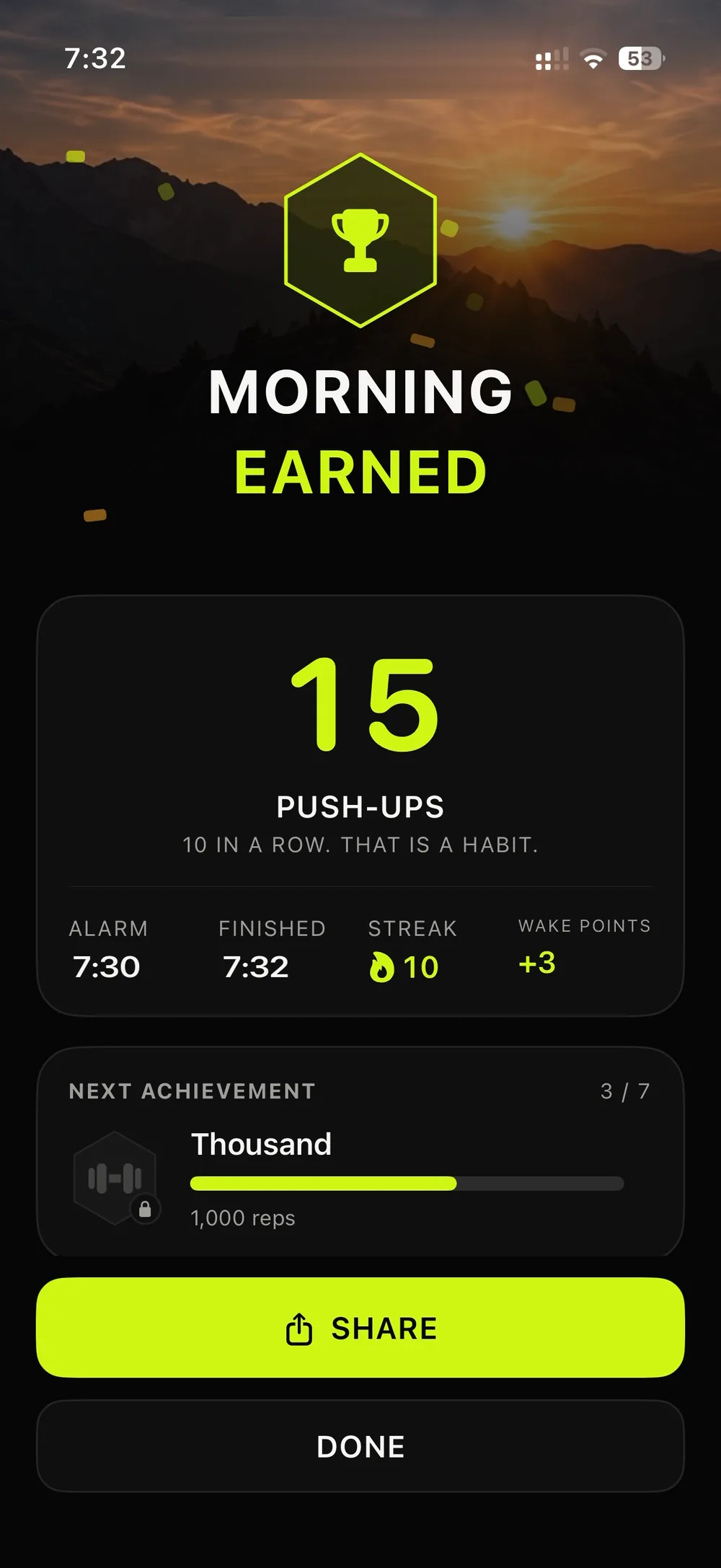
The camera counts each full rep on your phone, with no video recorded or uploaded, and the morning counts as earned when you reach your number.
The short version
- There's no universal number. Choose one you can do with good form on a bad morning: often 5 to 10 push-ups to start.
- A morning set gets you up. For strength, the WHO recommends working all major muscle groups at least twice a week.
- Being able to do 40 push-ups is a sign of fitness, not a daily target.
- Right after waking is fine for most people. Keep your back straight and skip deep forward bends first thing.
Sources
Bull FC, Al-Ansari SS, Biddle S, et al. World Health Organization 2020 guidelines on physical activity and sedentary behaviour. British Journal of Sports Medicine. 2020;54(24):1451–1462. doi:10.1136/bjsports-2020-102955
Momma H, Kawakami R, Honda T, Sawada SS. Muscle-strengthening activities are associated with lower risk and mortality in major non-communicable diseases: a systematic review and meta-analysis of cohort studies. British Journal of Sports Medicine. 2022;56(13):755–763. doi:10.1136/bjsports-2021-105061
Yang J, Christophi CA, Farioli A, et al. Association between push-up exercise capacity and future cardiovascular events among active adult men. JAMA Network Open. 2019;2(2):e188341. doi:10.1001/jamanetworkopen.2018.8341
Kovac K, Vincent GE, Paterson JL, Reynolds A, Aisbett B, Hilditch CJ, Ferguson SA. The impact of a short burst of exercise on sleep inertia. Physiology & Behavior. 2021;242:113617. doi:10.1016/j.physbeh.2021.113617
Adams MA, Dolan P, Hutton WC. Diurnal variations in the stresses on the lumbar spine. Spine. 1987;12(2):130–137. doi:10.1097/00007632-198703000-00008
Snook SH, Webster BS, McGorry RW, Fogleman MT, McCann KB. The reduction of chronic nonspecific low back pain through the control of early morning lumbar flexion: a randomized controlled trial. Spine. 1998;23(23):2601–2607. doi:10.1097/00007632-199812010-00015
Keep reading
All articles →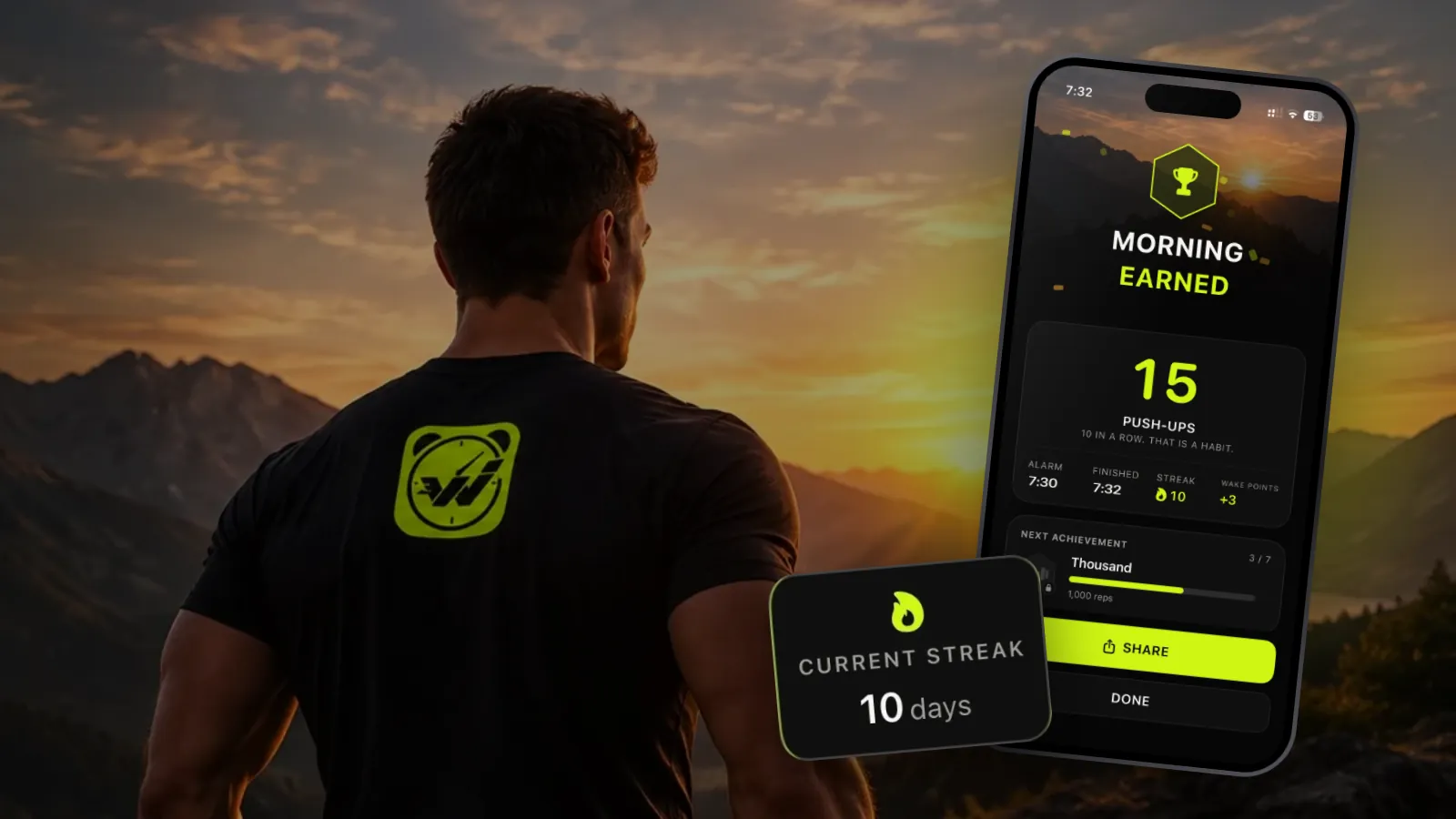 Guides
How to get out of bed when your alarm goes off: the first 10 minutes
Nothing makes you sharp the second you wake up, and the research is honest about that. What does help is getting vertical fast. A minute-by-minute plan, with what's evidence and what's just habit.
4 October 2026 · 7 min read
 Guides
How to stop snoozing your alarm: a 7-day plan
Snoozing itself isn't the enemy. A snooze that never ends is. Here is why the button wins, what helps, and a one-week plan to get up on the first ring.
4 October 2026 · 7 min read
 Guides
I turn off my alarm in my sleep. What can I do?
Why you can silence an alarm and have no memory of it, how common it is, when it's worth asking a doctor, and seven fixes, from the easiest to the strongest.
4 October 2026 · 8 min read
Coming soon to iPhone
Your number, every morning.
Choose push-ups or squats and how many when you set the alarm. The camera counts each full rep, and the morning is yours when you hit the number.
Not in the App Store yet. wakeletics.app walks you through the whole app.