

Research
Does it matter what time of day you exercise?
The largest review of exercise timing looked at 35 studies and 17,259 people. Its conclusion is not the one the internet keeps repeating.
By Daniel & Samuel Krucay, co-founders of Wakeletics
· 20 August 2026 · 6 min read

There is a genre of morning-routine content that treats sunrise workouts as metabolically sacred. Train before 8 AM and you burn more fat, sleep better, live longer. It is a tidy story. It is also not what the evidence says.
What the biggest review found
In 2022, a team led by Ian Janssen at Queen's University published a systematic review in Health Promotion and Chronic Disease Prevention in Canada. They pulled together 35 studies covering 17,259 participants and looked at what happens when you move the same exercise to a different hour — across sleep quality, body fat, muscle size, cardiometabolic markers, physical function, mental health, and risk of cardiovascular disease, cancer and death.
Their conclusion, stated plainly:
There is no consistent evidence that physical activity at one time of day provides more favourable health benefits than physical activity at a different time of day.
Not "mornings win by a small margin." Not "the jury is out but early looks promising." When the results were sorted by direction, roughly a third of studies favoured morning, a third favoured later, and a third found nothing at all. That is what a genuine null result looks like.
Why this is good news
If the clock were the deciding variable, most people would be stuck. You cannot move your shift, your children, or your commute.
But if the hour barely matters physiologically, then the only variable left is the one you actually control: whether the workout happens at all. A perfect 6 AM session you skip four days a week loses to a mediocre 7 PM session you never miss. The research does not tell you when to train. It quietly tells you to stop optimising the calendar and start optimising your adherence.
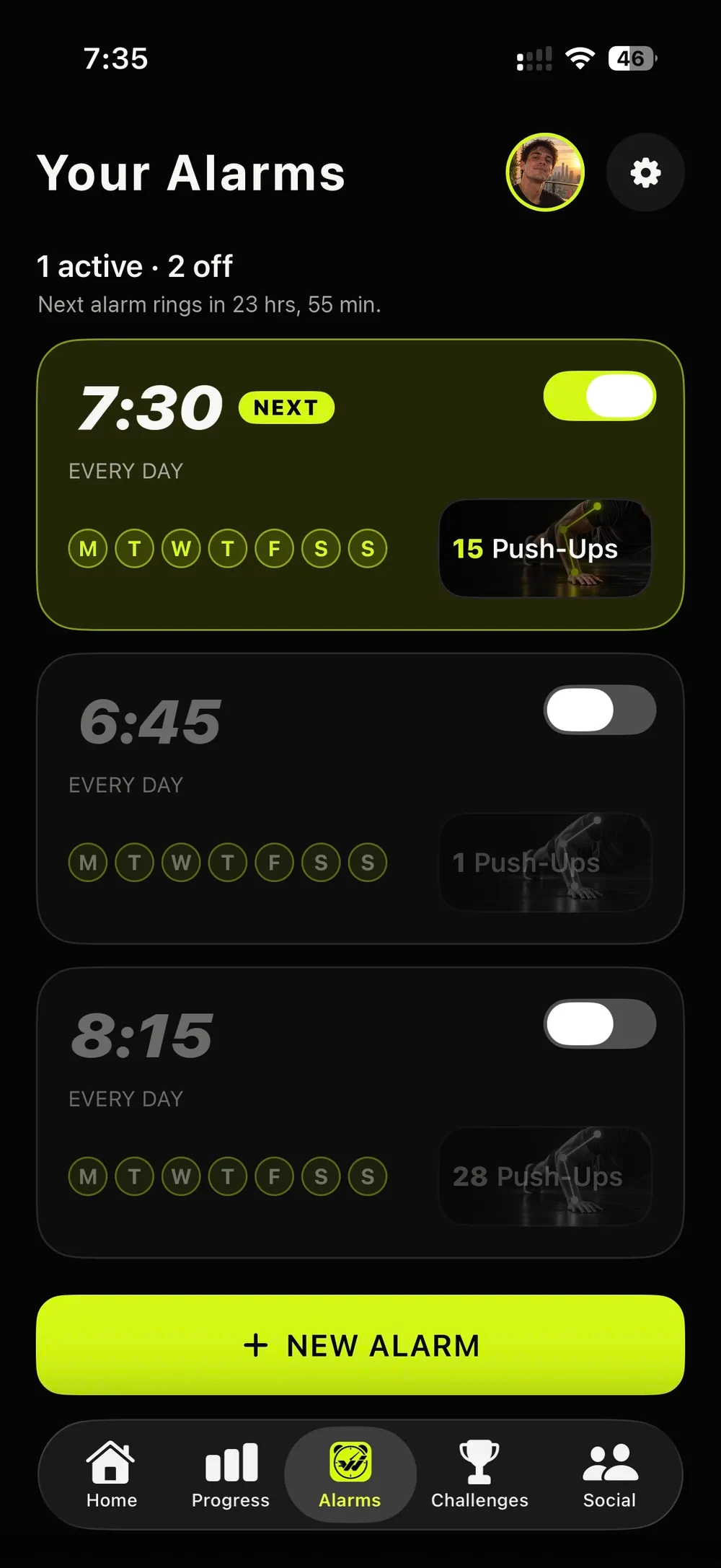
So why build a morning app?
Because "when is optimal" and "when is easiest to protect" are different questions, and only the first one has been studied to death.
Morning has one structural advantage that has nothing to do with metabolism: almost nothing else has happened yet. Nobody has scheduled a late meeting over it. No one has invited you to dinner. You are not tired from a day that went sideways. The evening version of you has to defend a workout against everything the day throws; the morning version only has to defend it against a duvet.

That is a logistical argument, not a biological one, and it is worth being precise about the difference. Wakeletics is built on the logistical claim. We are not going to tell you that push-ups at 6:30 burn differently than push-ups at 18:30, because as far as the best available evidence goes, they do not.
What to take from this
- Pick the time you can defend, not the time that sounds optimal. The evidence gives you permission to choose on practical grounds.
- Consistency of timing is worth more than the timing itself. Training at a stable hour builds a cue; jumping around the clock does not.
- Be suspicious of anyone selling a specific hour. If a 17,000-person review could not find a consistent winner, a blog post is unlikely to have.
Source
Janssen I, Campbell JE, Zahran S, Saunders TJ, Tomasone JR, Chaput JP. Timing of physical activity within the 24-hour day and its influence on health: a systematic review. Health Promotion and Chronic Disease Prevention in Canada. 2022;42(4):129–138. doi:10.24095/hpcdp.42.4.02
Keep reading
All articles → Research
Your alarm sets your schedule. Light sets your clock.
An alarm decides when you open your eyes. What decides whether your body agrees is the light you get in the following hour — and indoor lighting barely registers.
27 August 2026 · 6 min read
 Research
The weekend lie-in has a name, and a cost
About 70% of working people carry a permanent two-hour time-zone shift between their weekdays and weekends. Chronobiologists call it social jetlag.
26 August 2026 · 7 min read
 Research
How long until a morning workout stops being a decision?
Not 21 days. The real study found a median of 66 — and a range wide enough to explain why most habit advice fails you.
25 August 2026 · 6 min read
Coming soon to iPhone
Pick your hour. Defend it.
6:45, 7:30 or whenever you can protect — set it once, earn it with push-ups or squats, every morning.
Not in the App Store yet. wakeletics.app walks you through the whole app.